Author: Sutun Nayak

  • Human Capital Breakthrough at the India AI Impact Summit 2026

    Human Capital Breakthrough at the India AI Impact Summit 2026

    New Delhi [India], January 6: On January 5 and 6, 2026, the IndiaAI Mission, the Ministry of Electronics and Information Technology, the Government of Assam and IIT Guwahati held a two-day Human Capital Working Group meeting. On paper, it appeared as yet another policy consultation. At ground level, it was a fresh start.

    It did not involve selling AI as a silver bullet. It was about asking embarrassing questions. Who benefits from AI? Who gets displaced? Who gets left behind when there is not enough speed, and who gets trampled when there are no guardrails?

    The discussions will directly contribute to the India AI Impact Summit 2026, which will take place in New Delhi. That fact alone signals seriousness. Human capital is no longer a periphery. It is the spine.
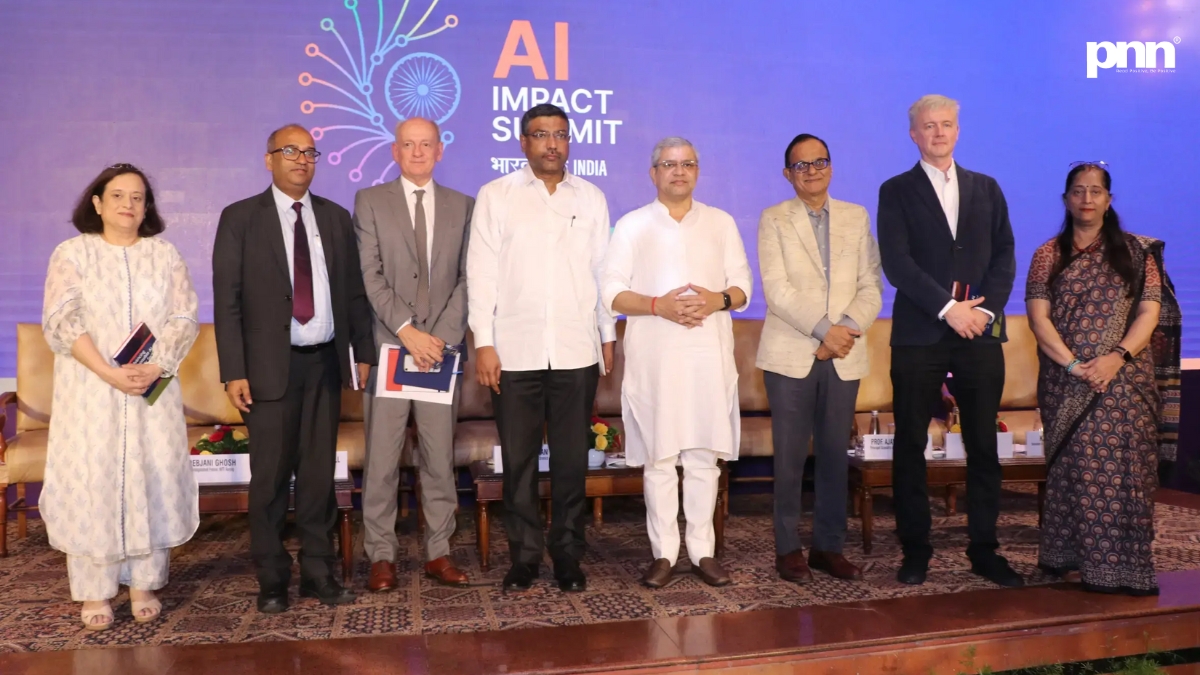
    Human Capital Breakthrough at the India AI Impact Summit 2026-PNN

    Guwahati as the Policy Testbed

    There is symbolism in Assam hosting this meeting. India’s AI policy has been metro-heavy. New Delhi drafts. Bengaluru builds—Hyderabad scales. Holding national AI human capital talks in Guwahati turns that equation on its head.

    Prof. Devendra Jalihal, Director of IIT Guwahati, set the pace. He positioned the institute not just as a technology hub, but as a gathering ground where policy, academia, industry and students intersect. Student involvement was not cosmetic. It reflected a generation that understands AI will shape their jobs whether policymakers like it or not.

    It was also here that regional perspectives entered national policy thinking. Northeast India is not an AI appendix. It is an inclusion-and-adoption test case.

    Human Capital and Lifelong Learning: The Big Pivot

    If there was one phrase repeated across sessions, it was this: skilling is not enough.

    Prof. T. G. Sitharam, Chair of the Human Capital Working Group, was direct. Piecemeal skilling programmes will not survive the AI economy. India needs lifelong learning ecosystems that value flexibility, judgment and human-centred capabilities alongside technical skills.

    Translation: teaching Python once and calling it future-ready is a bad joke.

    The focus shifted from automation to augmentation. AI should expand human capability, not replace it. This is not only a philosophical shift, but an economic one. Given India’s workforce scale, mass displacement is not hypothetical. It is a political and social reality.

    This concern was reinforced by Shri K. S. Gopinath Narayan, Principal Secretary (IT), Government of Assam, who cautioned that unchecked automation could widen inequalities across regions and sectors. His emphasis on micro-skilling, continuous learning and AI literacy framed these not as elite skills, but as public capabilities.

    India AI, the Global South and the Sovereignty Question

    Ms Shikha Dahiya, Joint Director, IndiaAI, explained why the India AI Impact Summit 2026 matters beyond India. It is not just about domestic readiness, but about shaping a Global South narrative on AI.

    IndiaAI’s work on compute capacity, indigenous datasets and homegrown models was positioned as foundational to human capital development. Without sovereign AI infrastructure, human capital strategies risk collapsing into dependency.

    This matters because AI power is already concentrated globally. Shri Syedain Abbasi, Special Chief Secretary, Government of Assam, did not soften his words. AI today is not merely a tool, but an autonomous agent. That changes the risk profile entirely.

    He also voiced what many policy rooms avoid acknowledging. India’s traditional IT and outsourcing employment model is vulnerable. If AI capability remains concentrated among a few global players, job erosion will not be gradual. It will be abrupt.

    The response, as discussed, lies in indigenous computing, public–private collaboration and differentiated skilling pathways across education levels.

    Human Capital and Gender Inclusion in the AI Workforce

    One of the most grounded discussions focused on gender-responsive strategies for the AI transition. This was not a checkbox session.

    Panellists highlighted risks already visible on the ground—automation of entry-level roles with high female participation. Wage gaps widened by unequal access to AI skills—bias embedded in data and algorithms.

    The message was consistent. Inclusion cannot be retrofitted. It must be built into AI systems, skilling programmes and adoption strategies from the start.

    Moderated by Ms. Arpitha Desai of The Asia Group, the panel brought together voices from government, industry and academia. The focus was on explainable AI, adoption-led reskilling and ecosystem-driven policy interventions. Not slogans. Systems.

    Reinventing Education for the Cognitive Age

    Perhaps the most consequential session centred on education reform. The term “cognitive age” was used deliberately.

    The panel on redefining education examined how AI is reshaping learning objectives, pedagogy and assessment. Rote memorisation was declared obsolete. Process-oriented and cognitive learning took centre stage.

    Used well, AI can personalise learning and reduce administrative burdens on teachers. Used poorly, it can reduce education to scaled content consumption.

    Panellists stressed the need for human-centric, community-tested AI tools and closer alignment between education systems and fast-evolving industry requirements. Adaptability, critical thinking, collaboration and lifelong learning emerged as non-negotiables.

    This is where India’s demographic advantage will either compound or collapse.

    Human Capital Implications for the India AI Impact Summit 2026

    The Guwahati meeting is not an end in itself. It is a funnel.

    Its outcomes will be consolidated into recommendations that inform national policy decisions and global-level discussions at the India AI Impact Summit 2026. That summit will culminate in leaders’ plenaries and working group outcomes in New Delhi.

    The throughline is unmistakable. India is positioning human capital not as collateral damage of AI, but as its primary beneficiary.

    This aligns squarely with the vision of Viksit Bharat 2047. Growth without dignity is not development. AI without inclusion is not progress.

    India AI Impact Summit 2026
    India AI Impact Summit 2026 – official summit portal

    Official IndiaAI Mission 
    Ministry of Electronics & Information Technology – IndiaAI Mission official page
    PNN News

  • How India’s Power Distribution Sector Is Pulling Off a Turnaround

    How India’s Power Distribution Sector Is Pulling Off a Turnaround

    New Delhi [India], January 6: For decades, power distribution was the weakest link in India’s energy chain. Now, after years of bruising reforms, the numbers are finally blinking green.

    Power distribution sits where ambition meets reality. You can build solar parks, commission wind farms, and talk up electric mobility all day. But if distribution utilities bleed cash and leak power, the system collapses quietly. That has been India’s recurring problem.

    High Aggregate Technical and Commercial losses. Chronic debt. Endless bailouts. And a reputation for being reform-proof.

    Something has shifted.

    The India power distribution sector turnaround is no longer a policy slide or a hopeful projection. FY 2024–25 numbers show measurable change. Not cosmetic. Structural.

    Why the Distribution Sector Matters More Than Ever

    India’s clean energy target of 500 GW of non-fossil capacity isn’t just about generation. It depends on whether distribution utilities can absorb variable renewables, manage decentralised grids, and support electric mobility without blowing financial fuses.

    DISCOMs are the gatekeepers. If they’re weak, renewable integration stalls. If they’re broke, grid upgrades don’t happen. If they’re opaque, investors stay cautious.

    That’s why the government’s reform strategy has focused relentlessly on distribution. Not glamorous. Not headline-friendly. But unavoidable.

    The results are now visible.

    FY 2024–25: Numbers That Actually Matter

    Let’s start with efficiency. Aggregate Technical and Commercial losses have dropped from 22.62 percent in FY14 to 16.16 percent in FY25. That’s not a rounding error. That’s years of metering, feeder separation, billing discipline, and less tolerance for leakage.

    Then comes the money gap that haunted DISCOMs for years. The Average Cost of Supply minus Average Revenue Realised gap has narrowed sharply.

    From ₹0.78 per unit in FY14 to just ₹0.11 per unit in FY25. Translation: utilities are finally recovering what it costs to supply power.

    And then the headline moment. For the first time ever, India’s power distribution utilities posted a positive Profit After Tax. ₹858 crore in FY25. Compare that to a loss of ₹67,962 crore in FY14. That swing didn’t happen by accident.

    Payment discipline has also tightened. Outstanding dues to generating companies collapsed by 96 percent. From ₹1.39 lakh crore in 2022 to ₹5,747 crore by December 2025. Payment cycles shortened from 176 days in FY21 to 120 days in FY25. Not perfect, but moving in the right direction.

    Perhaps the most telling signal is this. Accumulated losses declined year-on-year for the first time. From ₹6.92 lakh crore in FY24 to ₹6.39 lakh crore in FY25. That’s a psychological break from the past.

    What Changed Under the Hood

    This turnaround didn’t come from one scheme or one announcement. It came from layering reforms until escape routes closed.

    Late Payment Surcharge Rules forced utilities to respect contracts. Miss payments, pay penalties. Simple. Effective.

    Tariff rationalisation rules pushed states to stop pretending electricity is free. Costs had to be recognised. Subsidies had to be accounted for transparently.

    Financial discipline was reinforced by linking borrowing permissions to reform performance. Want more fiscal headroom? Fix your DISCOM first.

    Operationally, smart metering and infrastructure upgrades under the Revamped Distribution Sector Scheme began plugging leakages at the consumer end. Not dramatic. Just relentless.

    Union Power Minister Manohar Lal has repeatedly hammered the same point. A future-ready power sector needs financially strong distribution utilities. Affordable power doesn’t mean bankrupt utilities. It means efficient ones.

    The Legacy Burden Still Looms Large

    Now, let’s not get carried away.

    Despite progress, distribution utilities still carry ₹6.39 lakh crore in accumulated losses and ₹7.18 lakh crore in debt as of FY25. Nearly 80 percent of this burden sits with a handful of states. Tamil Nadu. Rajasthan. Maharashtra. Andhra Pradesh. Uttar Pradesh. Telangana. Madhya Pradesh. Karnataka.

    These aren’t small players. They shape national outcomes.

    The India power distribution sector turnaround will stall if these structural pockets aren’t addressed. Political reluctance to raise tariffs. Delayed subsidy payments. Operational inefficiencies. They still exist.

    Reforms have arrested the fall. Sustaining the climb is the real test.

    Why This Matters for Viksit Bharat 2047

    The government has framed distribution reform as a pillar of Viksit Bharat 2047. That’s not rhetoric. It’s arithmetic.

    A green, digital energy future needs utilities that can invest. In smart grids. In storage integration. In EV charging infrastructure. None of that happens if balance sheets are broken.

    The Electricity Distribution (Accounts and Additional Disclosure) Rules, 2025 aim to standardise accounting and expose financial reality. Transparency is uncomfortable. But it’s necessary.

    Additional prudential norms now tie access to finance with performance benchmarks. No more blank cheques.

    Amendments to electricity rules enforce timely cost adjustments and realistic tariffs. Politics aside, electricity has to be paid for.

    Together, these measures are reshaping incentives. Slowly. Sometimes painfully. But clearly.

    The Quiet Confidence Behind the Numbers

    What’s striking is the tone shift. Earlier, every improvement came with caveats and disclaimers. Now, officials talk about sustaining gains, not rescuing failures.

    That’s a subtle but important change.

    The distribution sector isn’t fixed. But it’s no longer in free fall. And that alone changes investor confidence, renewable integration timelines, and state-level accountability.

    For India’s energy transition, this is foundational work. Unsexy. Uncelebrated. But decisive.

    Read More

  • Surat Literature Festival 2026: A Platform For National Ideas Beyond The Metros

    Surat Literature Festival 2026: A Platform For National Ideas Beyond The Metros

    Surat (Gujarat) [India], January 5: As India approaches the centenary of Independence, debates on culture, governance and national direction remain concentrated in a few metropolitan centres.
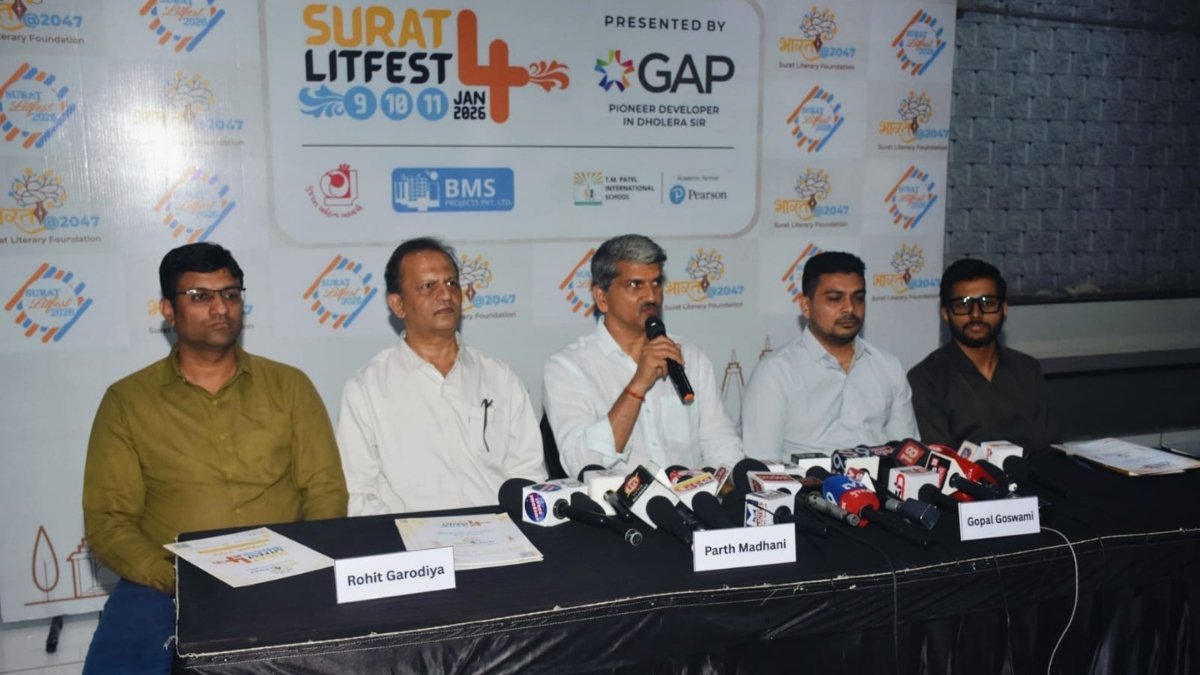
    It is against this backdrop that the Surat Literature Festival returns for its fourth edition from 9 to 11 January 2026 at Veer Narmad South Gujarat University, seeking to widen the geography of India’s intellectual life and anchor serious public conversations beyond the metros.

    Conceived not merely as a literary gathering but as a forum for ideas, policy debate and cultural reflection, Surat LitFest has steadily grown in scale and ambition. Its third edition in 2025 was organised within the broader framework of Bharat@2047 and brought together policymakers, scholars, defence experts, scientists and cultural figures to reflect on India’s long-term national journey.

    Discussions ranged across governance, national security, education, media, the economy and indigenous knowledge systems, signalling a move beyond conventional festival programming.

    The 2025 edition featured speakers such as former ISRO chairman Dr A. S. Kiran Kumar, former Chief Justice of India Ranjan Gogoi, Lt Gen N. S. R. Subramani and economist Dr Shamika Ravi. A strong cultural programme complemented these discussions, drawing large and engaged audiences and establishing a format that has since become a defining feature of the festival.

    Viksit Bharat 2047 and Civic Purpose

    In recent years, Surat LitFest has explicitly linked its conversations to the idea of Viksit Bharat 2047, a national vision that seeks to make India a developed country by the centenary of Independence. The framework places emphasis on inclusive growth, infrastructure and technological advancement, human capital development and institutional reform.

    Within this context, the festival has positioned discussions on education reform, strategic autonomy and indigenous knowledge systems as practical contributions to the national roadmap. Organisers and speakers have argued that intellectual self-reliance and cultural confidence are essential to long-term transformation, alongside economic and technological progress.

    Civilisational Questions in Public Debate

    Alongside policy and economic themes, the festival has foregrounded conversations reflecting a broader civilisational reawakening in contemporary India. These sessions seek to reintroduce classical knowledge, spirituality and cultural memory into modern public discourse—not as nostalgia but as living frameworks shaping society and governance.

    Panels at the 2025 edition explored Indian knowledge systems and Dharmic heritage in relation to nation building, education and public ethics. This integration of civilisational inquiry with policy debate distinguishes Surat LitFest from many metropolitan literary events.

    Literature Festival

    A Broader 2026 Programme

    The fourth edition promises to be larger and more ambitious, with a structured three-day programme of thematic sessions.

    Day One will open with an inaugural ceremony featuring Swami Paramatmanand Ji, Dr Bhagyesh Jha, Shri Kishor Makwana and Shri Ratnakar Ji, followed by a cultural evening of folk and classical performances.

    Day Two will feature sessions on Rashtriya Suraksha, Technological Warfare & Bharat, Media, Dharma & Gen Z, and Cinema & Bharat@2047, with speakers including Major Gen Shashi Asthana, Vice Admiral Shekhar Sinha, Dr B K Das, Dr G K Goswami, Dushyanth Sridhar, Vishnu Shankar Jain, Pratik Gandhi and filmmaker Sudipto Sen.

    Day Three will focus on Mahila Shakti@2047, Rajneeti@2047, RSS@100, Education & Bharat@2047, and Communism & Bharat@2047, featuring voices such as Tehseen Poonawalla, Ajeet Bharti, Pradeep Bhandari, Meghna Pant, Prof M Jagadesh Kumar, Shri Ram Lal Ji and Dr Dilip Mandal.

    Culture at the Core

    Cultural programming remains central to the festival’s identity. Highlights include the theatrical production ‘Hu Chandrakant Bakshi’, performed by actor Pratik Gandhi on 10 January and billed as the festival’s crown jewel.

    A large folk and classical showcase titled Rhythms of India will bring together Kathak, Bharatanatyam, Yakshagana, Kalaripayattu and Tamasha performances by artists from across the country, alongside musical and dance events across all three days.

    Surat as a City of Ideas

    From a historic port city to one of India’s most dynamic commercial centres, Surat has long been associated with enterprise, textiles and diamonds. The festival seeks to leverage this economic energy to build a durable platform for national conversations beyond traditional cultural hierarchies.

    At a time when India’s intellectual life remains metro-centric, platforms like Surat LitFest signal a quiet but significant shift. By rooting national conversations in a non-metro city, the festival challenges the assumption that serious ideas must originate in Delhi or Mumbai.

    Its emphasis on civilisational confidence, public policy and cultural continuity suggests that India’s emerging intellectual landscape will be broader, more decentralised and more representative.

    Surat Literature Festival 2026 will be held from 9 to 11 January at Veer Narmad South Gujarat University.
    Further details are available at www.srtlitfest.com.

  • Building Trust, Brick by Brick: How Samarpan Group Is Shaping Mumbai’s Residential Future

    Building Trust, Brick by Brick: How Samarpan Group Is Shaping Mumbai’s Residential Future

    Mumbai (Maharashtra) [India], 1 January: In a city where space is limited and trust is essential, Mumbai Trusted Real Estate is more than just a phrase; it is a vow that discerning homebuyers actively seek. With a heritage spanning nearly eighty years, the group, through its real estate arm Samarpan Homes & Developers, continues to redefine credibility, customer focus, and quality-led development across Mumbai’s most coveted suburbs.

    Rooted deeply in Mumbai’s evolving skyline, Samarpan Group has consistently built a reputation that combines traditional values with progressive design. Its presence across Borivali, Malad, and Andheri reflects a strategic vision centred on connectivity, livability, and long-term value; key pillars that define Mumbai’s trusted real estate today.

    A Legacy Anchored in Leadership and Values

    Samarpan Group -PNN

    At the core of Samarpan Group’s journey is the leadership of Shree Ramesh Jain, whose philosophy prioritises customer confidence above all else. Long before “customer-first” became an industry buzzword, the group practised it as a fundamental belief. This mindset has enabled Samarpan Homes & Developers to deliver projects that connect with both end users and investors.

    Over the years, the group has completed numerous residential developments in Borivali West and Borivali East—neighbourhoods that have become thriving residential hubs. Each completed project stands as a testament to consistency, ethical practices, and a long-term commitment to stakeholders. In an industry often driven by speed, Samarpan’s measured and quality-focused approach has helped it earn recognition as a name synonymous with Mumbai’s trusted real estate.

    Borivali: Strengthening Foundations in a Prime Suburb

    Borivali remains a central focus of Samarpan Group’s development initiatives. Current and upcoming projects, such as Bahubali CHSL in Saibaba Nagar, Nav Rajhans CHSL on Rokadia Lane, and Vanita CHSL on L.T. Road, are strategically located in Borivali West, providing residents with the benefits of established infrastructure and excellent connectivity.

    In Borivali East, developments including Krishnagiri Upavan and multiple residential offerings across Asara Colony and Dattapada Road—such as Samarpan Sankalp, Meghmahal, Swanand, Siddhesh, and Rajdeep—cater to modern urban families seeking spacious 2BHK and 3BHK homes. These projects combine efficient layouts with proximity to transport corridors, reinforcing the group’s understanding of what today’s homeowners truly value.

    For readers exploring Borivali’s growth potential, resources like the
    https://mumbaicity.gov.in/
    and
    https://mmrda.maharashtra.gov.in/

    offer valuable insights into infrastructure and regional planning.

    Malad Projects Designed for Urban Comfort

    Extending its footprint westward, Samarpan Group’s presence in Malad reflects a nuanced approach to urban living. Samarpan Utopia, located on Chincholi Bunder Road, introduces a residential environment where space, comfort, and thoughtful design converge. With 1, 2, and 3 BHK configurations, the project appeals to both young professionals and growing families.

    Complementing this is Samarpan CHS in Malad West, positioned as a premium residential option that balances privacy with accessibility. Together, these developments reinforce the group’s ability to tailor its offerings to diverse buyer profiles while maintaining the standards expected of a Mumbai-trusted real estate developer.

    For an overview of Malad’s residential appeal, readers may explore
    https://www.magicbricks.com/Malad-in-Mumbai-Overview

    for locality insights and market trends.

    Andheri: The Next Chapter of Expansion

    Looking ahead, Samarpan Group’s upcoming projects in Andheri East—Samarpan Serenity CHSL and Nav Samrat—mark a confident step into one of Mumbai’s most vibrant commercial-residential areas. Known for its proximity to business districts, metro connectivity, and social infrastructure, Andheri offers both opportunity and responsibility.

    True to its legacy, the group is approaching this expansion with the same focus on quality, compliance, and customer satisfaction. These developments are expected to align smoothly with professionals’ and families’ expectations for well-connected homes without compromising construction integrity.

    For a broader context on Andheri’s infrastructure growth,
    https://www.mid-day.com/mumbai/andheri offers regular updates and coverage of urban development.

    A Vision Rooted in Trust and Continuity

    As Mumbai’s real estate scene continues to develop, Samarpan Group remains focused on a clear goal: to be recognised as one of the city’s top three most trusted developers. This ambition is driven not just by size, but by ongoing confidence from customers, partners, and communities.

    By blending legacy experience with contemporary planning sensibilities, Samarpan Homes & Developers exemplifies what Mumbai-trusted real estate should stand for—reliability, transparency, and homes built for generations, not just transactions.

  • Surbhi Group: Redefining Urban Lifestyle

    Surbhi Group: Redefining Urban Lifestyle

    Mumbai (Maharashtra) [India], January 2: At Surbhi Group, we believe real estate is not just about properties—it’s about people, possibilities, and purpose. Since our founding in 2000, we have delivered nearly one million square feet with a clear mission: to redefine the urban lifestyle by creating thoughtfully designed homes that reflect modern living while remaining deeply rooted in tradition, trust, and community.

    Visionary Leadership

    Mr. Mitesh Shah, the visionary founder of Surbhi Construction, brings with him a rich legacy of over three decades in the real estate industry. He firmly believes that quality is not merely a destination, but an ongoing journey toward excellence.

    Timely project execution, innovative design thinking, and a strong commitment to sustainability give Surbhi Construction a distinct edge in a competitive market.

    Under his leadership, Surbhi Construction has expanded manifold, developing a diverse portfolio of residential and commercial projects. Driven by a passion for architecture and design, Mr. Shah has been instrumental in engineering iconic structures that have reshaped the urban landscape.

    Our Team

    Our skilled team of engineers, contractors, and project specialists brings technical expertise, precision, and an uncompromising commitment to quality to every project—ensuring timely delivery, structural excellence, and long-term value for clients, partners, and communities alike.

    Our Core Philosophy

    Simple yet powerful.

    Whether you’re a first-time homebuyer, investor, or a growing family, we are committed to offering homes that match your aspirations—crafted with integrity, backed by transparency, and guided by enduring values.

    Key Achievements

    • 95%+ customer satisfaction rate, supported by strong referrals and repeat buyers

    • Recognised as a Most Trusted Residential Brand by Mumbaikars

    • Successful delivery of residential projects featuring modern amenities, green design, and connectivity-first locations

    Our Focus

    Our developments are carefully planned to serve the needs of today’s urban dweller:

    • Prime locations near metro stations, IT hubs, schools, and hospitals

    • Well-designed spaces balancing privacy, community, and sustainability

    • Integration of modern amenities such as smart security, fitness zones, co-working lounges, and green courtyards

    • Walkable neighbourhoods that encourage wellness and social interaction

    We don’t just build homes—we design lifestyles that seamlessly blend convenience, connectivity, and culture.

    Our Promise

    At the heart of everything we do lies trust. We ensure:

    • Complete legal and title transparency

    • Ethical pricing with clear documentation

    • End-to-end support from site visits to possession

    • Responsive after-sales service and ongoing community support

    We’re not just selling homes—we’re building long-term relationships.

    Meet Dynamic and Contemporary Second-Generation Leader TEJ MANISH SHAH

    Tej Manish Shah is a second-generation leader and currently serves as the Director of the company. Building upon the legacy of the founding generation, he brings a dynamic and contemporary leadership style—merging deep-rooted family values with forward-thinking strategies.

    With a background in civil engineering and hands-on experience in project execution, Tej plays a pivotal role in expanding the company’s footprint, driving innovation, and enhancing operational efficiency. Under his leadership, Surbhi Construction continues to evolve while remaining true to its core principles and long-standing reputation.

    If you have any objection to this article’s content, kindly contact pr.error.rectification@gmail.com to notify us. We will respond and rectify the situation in the next 24 hours.

  • Raj Computers Academy Celebrates Three Decades of Impact in IT Skill Education in India

    Raj Computers Academy Celebrates Three Decades of Impact in IT Skill Education in India

    New Delhi [India], January 2: In a milestone moment that celebrates innovation, impact, and inclusive education, Raj Computers Academy proudly marks 30 years of dedicated service in IT and skill-based learning with an inspiring legacy of empowering students across India. What began in 1996 as a passion-driven initiative to democratize computer education has now evolved into one of the most respected institutions in the sector — a trusted launchpad for careers, entrepreneurship, and contribution to the nation’s digital transformation.

    Training over seven lakh students to date, the academy’s journey reflects not just remarkable numbers but the real achievements of learners whose success stories now echo in industries, startups, and digital ecosystems nationwide.

    At the heart of this sustained success is a simple philosophy: education should be accessible, relevant, and transformative — and this IT Skill Education India institution has stayed true to that principle through three productive decades.

    Vision Meets Purpose: From Modest Beginnings to National Recognition

    Founded with the vision to make computer education affordable and accessible to learners from all walks of life, Raj Computers Academy has steadily built a reputation for practical, employment-oriented training. Its impact goes far beyond certificates — it cultivates confidence, competence, and career readiness in an era where digital skills are increasingly essential.

    Reflecting on this historic journey, Dr. CA Rajesh Chheda, the founder and guiding force of the academy, describes the experience as profoundly fulfilling. “Growth, for us, has always been measured by the success of our students,” Dr. Chheda shared, highlighting the institution’s role in shaping careers, fueling entrepreneurship, and empowering contributors to the Digital India mission.

    Such dedication to meaningful learning has helped the academy forge strong partnerships with industry players, embed real-world relevance into its curriculum, and create pathways for students to enter technology, business, and innovation sectors with confidence.

    Leadership with a Collaborative Edge

    A defining driver of the academy’s evolution has been its leadership philosophy — one rooted in collective progress rather than individual acclaim. Under Dr. Chheda’s stewardship, the organization has embraced responsibility, vision, and collaboration as central pillars of growth.

    From innovative educational frameworks to active contributions to academic literature, Dr. Chheda’s leadership has always emphasized shared success. His belief in inclusive participation has shaped both strategy and culture, making Raj Computers Academy not just a training center but an ecosystem — where students, faculty members, and franchise partners grow together.

    At the core of this ecosystem is the RCES (Collaborative Leadership Structure) model — a unique governance framework that invites franchise partners into decision-making around policies, strategy, and expansion. By moving away from a traditional top-down model, RCES fosters transparency, mutual trust, and shared ownership — a rare and powerful differentiator in IT Skill Education India.

    Raj Computers Academy

    Scaling New Heights: Nationwide Expansion with Purpose

    As it embarks on its next chapter, Raj Computers Academy has set its sights on ambitious expansion. With plans to establish over 300 franchise centers across India, the focus is on catalyzing digital skill development beyond major urban centers.

    Special emphasis is being placed on Tier-II and Tier-III cities — regions where access to quality IT education remains limited but increasingly vital. Driven by a franchise-friendly model that blends structured support with sustainable growth, the academy is creating opportunities in communities where digital empowerment can have the greatest social impact.

    This approach has already borne fruit — many franchise centers have been operational for 15 to 20 years, a testament to long-term partnerships that thrive on trust, shared vision, and consistent quality.

    A Thought Leader in Education and Knowledge Sharing

    Beyond his role as an education leader, Dr. Chheda is a prolific author whose writings reflect a commitment to lifelong learning and knowledge dissemination. His books — including Management Strategies and IT Companies, Learn TallyPrime, and the recently released From Startup to Success — offer insights that bridge theory and real-world application.

    “Writing sharpens thinking, encourages research, and generates ideas that strengthen leadership,” Dr. Chheda says, underscoring how continuous learning fuels both personal growth and institutional excellence.

    Through his books, he not only shares knowledge but inspires a generation of students, educators, and entrepreneurs to think critically and act purposefully.

    The Road Ahead: Innovation, Inclusivity, and Impact

    Looking forward, Raj Computers Academy envisions becoming one of India’s foremost IT and skill-development networks, with a presence in every major city and a reputation for quality that resonates across sectors.

    At the center of this vision are three strategic pillars:

    • Innovation in Digital Education: Continuously updating curriculum frameworks to match industry evolution and emerging technologies.

    • Hybrid Learning Models: Blending the best of online and offline instruction to enhance flexibility, accessibility, and engagement.

    • Employment-Oriented Training: Equip learners not just with technical skills but with career readiness, problem-solving abilities, and a sense of purpose.

    This holistic approach ensures that students graduate not only proficient but confident — ready to shape their futures and contribute meaningfully to India’s progress in the digital age.

    A Legacy of Empowerment and Shared Success

    As Raj Computers Academy turns 30, its legacy stands tall as a testament to vision-driven leadership, collaborative growth, and an unwavering commitment to quality education. It is a legacy built not just on milestones but on the lives transformed, careers launched, and possibilities unlocked.

    For learners seeking practical, future-ready skills — and for communities aspiring to bridge digital divides — this institution remains a beacon of opportunity and inspiration in IT Skill Education India.

    Congratulations to Raj Computers Academy on 30 years of excellence — and to the next chapter of empowering dreams through education.

  • From sustainability to resilience: why the present moment demands a deeper way of thinking

    From sustainability to resilience: why the present moment demands a deeper way of thinking

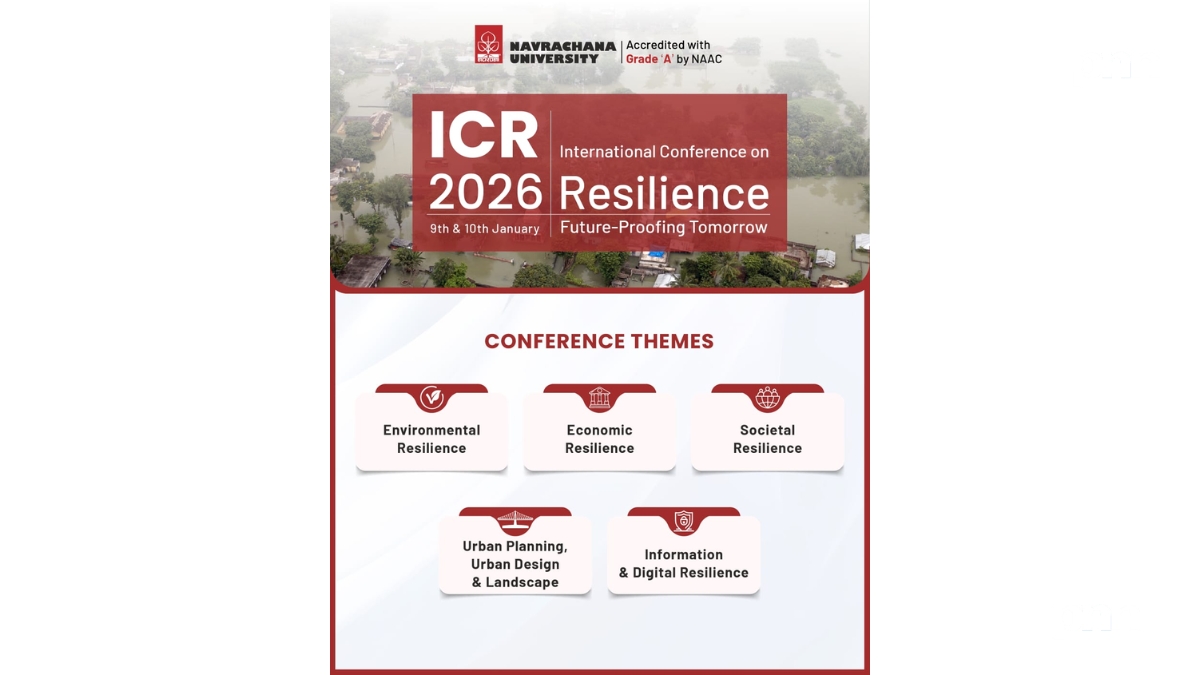
    International Conference on Resilience (ICR 2026)

    Vadodara (Gujarat) [India], January 5: For decades, sustainability has shaped how institutions, cities and communities think about growth and responsibility. While sustainability focuses on long-term balance and conservation, resilience responds to disruption, to shocks that are already unfolding and to uncertainties that cannot always be predicted. It is about the capacity to absorb stress, adapt in real time, and reorganise without losing core purpose. In today’s world of overlapping environmental, economic, digital and social challenges, resilience has emerged as a more immediate and action-oriented framework.

    It is within this evolving understanding that Navrachana University’s International Conference on Resilience (ICR 2026) is positioned, not as a conventional academic exercise, but as a response to conditions that cities, institutions and societies are actively navigating.

    The academic engagement with ICR 2026 reflects this urgency. Over 175 research abstracts have been received from universities, research institutions, industry organisations and independent practitioners across India and abroad, indicating a clear shift in scholarly focus, from ideal futures to adaptive strategies for present-day realities. All accepted and presented papers emerging from these submissions will be published as a Scopus-indexed book series by Springer Nature, further underscoring the academic significance and global visibility of the conference’s research outcomes.

    Speaking about the record number of abstract submissions received for the conference, Prof. Pratyush Shankar, Provost, Navrachana University, said, “The diversity and volume of submissions reflect how resilience is being examined today through interdisciplinary lenses—bringing together environmental studies, urban planning, economics, digital systems and social inquiry. This range of perspectives reinforces the need to approach resilience not in silos, but as an interconnected and evolving field of study.”

    What stands out equally is the geographical diversity of these submissions. Contributions have come from a wide spread of regions across India—including metropolitan centres, emerging cities and academic hubs—as well as from international institutions and organisations in countries such as the United States and Bangladesh. The presence of national institutes, schools of architecture and planning, universities, research councils, private studios, consultants and global technology and industry players underscores the conference’s reach beyond disciplinary and geographical boundaries, reinforcing resilience as a globally shared concern shaped by local realities.

    The thematic breadth of the submissions mirrors the complexity of current challenges. Environmental resilience addresses the intensification of climate events and ecological stress, while economic resilience responds to instability in markets, livelihoods and supply chains. Other submissions examine how cities and institutions respond to rapid change through planning, governance and adaptive design, reflecting the evolving scope of resilience as a multidisciplinary concern.

    These themes are not abstract. Vadodara’s own experiences with urban flooding, infrastructure pressure and heritage transformation offer tangible examples of how resilience differs from sustainability. While sustainability may ask how resources are preserved over time, resilience asks how cities function when systems fail, how communities recover after disruption, and how lessons are embedded into future planning.

    While the floods of Vadodara provide an important starting point, the conference deliberately broadens the conversation to examine resilience across interconnected systems. ICR 2026 engages with environmental and climate resilience alongside urban infrastructure and planning responses, economic resilience in the face of market and livelihood disruptions, societal and institutional resilience shaped by equity and governance, and information and digital resilience amid growing technological dependence. Together, these sub-themes reflect the understanding that contemporary challenges rarely occur in isolation and demand integrated, cross-disciplinary

    Vadodara, India, 5th January, 2026 – For decades, sustainability has shaped how institutions, cities and communities think about growth and responsibility. While sustainability focuses on long-term balance and conservation, resilience responds to disruption, to shocks that are already unfolding and to uncertainties that cannot always be predicted. It is about the capacity to absorb stress, adapt in real time, and reorganise without losing core purpose. In today’s world of overlapping environmental, economic, digital and social challenges, resilience has emerged as a more immediate and action-oriented framework.

    It is within this evolving understanding that Navrachana University’s International Conference on Resilience (ICR 2026) is positioned, not as a conventional academic exercise, but as a response to conditions that cities, institutions and societies are actively navigating.

    The academic engagement with ICR 2026 reflects this urgency. Over 175 research abstracts have been received from universities, research institutions, industry organisations and independent practitioners across India and abroad, indicating a clear shift in scholarly focus, from ideal futures to adaptive strategies for present-day realities. All accepted and presented papers emerging from these submissions will be published as a Scopus-indexed book series by Springer Nature, further underscoring the academic significance and global visibility of the conference’s research outcomes.

    Speaking about the record number of abstract submissions received for the conference, Prof. Pratyush Shankar, Provost, Navrachana University, said – “The diversity and volume of submissions reflect how resilience is being examined today through interdisciplinary lenses—bringing together environmental studies, urban planning, economics, digital systems and social inquiry. This range of perspectives reinforces the need to approach resilience not in silos, but as an interconnected and evolving field of study.”

    What stands out equally is the geographical diversity of these submissions. Contributions have come from a wide spread of regions across India—including metropolitan centres, emerging cities and academic hubs—as well as from international institutions and organisations in countries such as the United States and Bangladesh. The presence of national institutes, schools of architecture and planning, universities, research councils, private studios, consultants and global technology and industry players underscores the conference’s reach beyond disciplinary and geographical boundaries, reinforcing resilience as a globally shared concern shaped by local realities.

    The thematic breadth of the submissions mirrors the complexity of current challenges. Environmental resilience addresses the intensification of climate events and ecological stress, while economic resilience responds to instability in markets, livelihoods and supply chains. Other submissions examine how cities and institutions respond to rapid change through planning, governance and adaptive design, reflecting the evolving scope of resilience as a multidisciplinary concern.

    These themes are not abstract. Vadodara’s own experiences with urban flooding, infrastructure pressure and heritage transformation offer tangible examples of how resilience differs from sustainability. While sustainability may ask how resources are preserved over time, resilience asks how cities function when systems fail, how communities recover after disruption, and how lessons are embedded into future planning.

    While the floods of Vadodara provide an important starting point, the conference deliberately broadens the conversation to examine resilience across interconnected systems. ICR 2026 engages with environmental and climate resilience alongside urban infrastructure and planning responses, economic resilience in the face of market and livelihood disruptions, societal and institutional resilience shaped by equity and governance, and information and digital resilience amid growing technological dependence. Together, these sub-themes reflect the understanding that contemporary challenges rarely occur in isolation and demand integrated, cross-disciplinary approaches.

    From sustainability to resilience: why the present moment demands a deeper way of thinking-PNN

    Academic discussions at ICR 2026 draw from a body of scholarship that examines cities, environments and institutions as evolving systems shaped by historical, social and ecological forces. Rather than approaching resilience as a fixed outcome, this perspective treats it as a process—one that is continuously shaped by changing contexts, constraints and responses over time.

    This academic orientation finds institutional expression in KHOJ, which serves as a conceptual anchor for ICR 2026. Through KHOJ, students and researchers engage directly with real-world challenges—such as urban flooding, ecological stress and habitat transformation—using observation, documentation and field-based inquiry. The initiative emphasises learning through practice, enabling students to study contemporary challenges and actively explore how resilience can be built, tested and refined in response to lived conditions.

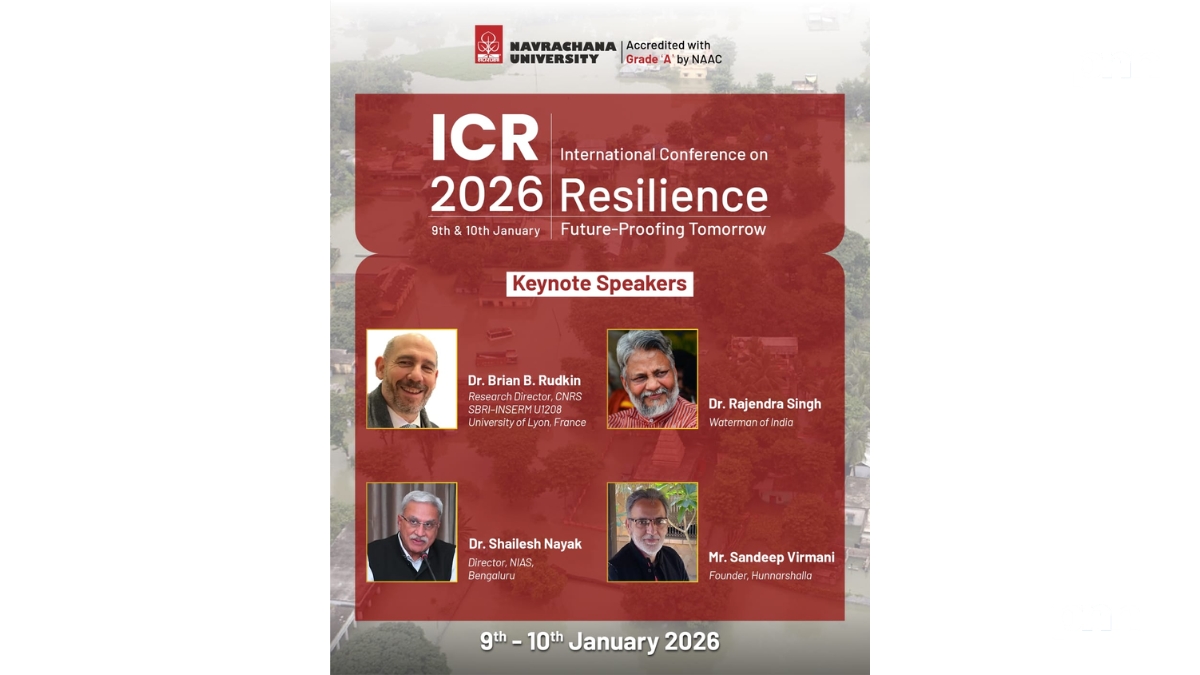
    Adding further depth to the conference discourse is the presence of distinguished keynote speakers whose work spans science, policy, environmental governance and global sustainability practice. Dr. Rajendra Singh, also known as the Waterman of India, widely recognised for his grassroots-led water conservation efforts, brings insights into community-driven ecological resilience. Mr. Sandeep Virmani, an environmentalist trained in architecture and based in Kutch, brings a community-rooted, practice-led perspective on ecosystems, traditional knowledge and habitat resilience. Padma Shri Shailesh Nayak, a leading voice in earth sciences and coastal systems, offers a macro-level understanding of climate risks, ocean systems and long-term environmental preparedness.

    Further strengthening the international dimension of the conference is the participation of Dr. Brian B. Rudkin, who will be joining from Lyon, France. Associated with One Sustainable Health, Dr. Rudkin brings global perspectives on sustainability, systems thinking and cross-sectoral resilience, enriching the conference dialogue with international practice-led insights. Together, their perspectives bridge practice, policy and science—strengthening the conference’s interdisciplinary foundation.

    The International Conference on Resilience (ICR 2026) will be held from January 9 to January 10, 2026, at the Navrachana University campus, Vadodara. Over two days, the conference will bring together researchers, practitioners and institutional leaders to examine how resilience—distinct from conventional sustainability—can shape more responsive, adaptable and inclusive futures.

    For more details – https://www.icr2026.com/

    If you object to the content of this press release, please notify us at pr.error.rectification@gmail.com. We will respond and rectify the situation within 24 hours.

  • The Convenient Future Is Watching You Back: Why 2026’s Tech Boom Feels Personal, Powerful—and Slightly Unsettling

    The Convenient Future Is Watching You Back: Why 2026’s Tech Boom Feels Personal, Powerful—and Slightly Unsettling

    Mumbai (Maharashtra) [India], January 5: By the time 2026 knocks properly, technology won’t be something people use. It will be something they inhabit.

    That distinction matters.

    For years, tech companies sold tools. Then they sold platforms. Somewhere along the way, they began selling presence. AI assistants that speak like companions. Wearables that know your heart better than you do. Devices that anticipate needs before you articulate them. Convenience has evolved from a feature to a philosophy.

    And like all philosophies that promise ease, it comes with conditions.

    The big story of 2026 isn’t faster processors or smarter apps. It’s how technology is quietly renegotiating daily life—rewriting habits, redefining privacy, and gently suggesting that humans might not be the most efficient managers of themselves.

    Charming. Efficient. Slightly alarming.

    Tech didn’t barge into lifestyle. It waited to be invited.

    Burnout culture, health anxiety, productivity guilt, digital fatigue—modern life laid the groundwork. Technology simply arrived with solutions wrapped in soft interfaces and friendly voices.

    And people said yes.

    When Utility Quietly Became Identity

    Once upon a time, owning tech signalled capability. In 2026, it signals selfhood.

    Wearables don’t just count steps anymore; they narrate wellness. AI assistants don’t just answer questions; they curate decisions. Ambient computing doesn’t demand attention; it dissolves into surroundings, like a well-trained butler who never asks permission.

    The upside:

    • Life feels smoother, less fragmented

    • Health insights are accessible, personalised, and  continuous

    • Cognitive load decreases—decisions outsource themselves

    The unease:

    • Autonomy becomes collaborative

    • Silence becomes data

    • Opting out starts to feel… inefficient

    Progress didn’t remove friction. It relocated it.

    Wearables And The Rise Of Measurable Humanity

    2026 marks the year wearables stopped being accessories and became self-quantification mandates.

    Sleep scores dictate mood. Heart-rate variability influences schedules. Stress metrics justify rest—or guilt. Wellness transforms into dashboards, and the body becomes a report card.

    This isn’t dystopian. It’s practical.

    Until it isn’t.

    Pros:

    • Early detection of health irregularities

    • Preventive care replaces reactive medicine

    • Individuals gain visibility into long-ignored patterns

    Cons:

    • Anxiety thrives on numbers without context

    • Data interpretation becomes moral judgment

    • Health shifts from feeling to compliance

    The body used to speak in sensations. Now it sends notifications.

    AI Assistants: From Help To Habit

    The AI companions of 2026 aren’t dramatic breakthroughs. They’re persistent presences.

    They schedule, summarise, remind, predict, nudge. They learn tone, preference, emotional rhythm. Not because they care—because it works.

    The seduction is subtle. Delegation feels rational. Resistance feels stubborn.

    But here’s the catch: when an assistant learns your patterns better than you reflect on them, who’s really deciding?

    Positive reality:

    • Time reclaimed from trivial decisions

    • Accessibility expanded for diverse users

    • Personalisation becomes genuinely helpful

    Less advertised trade-off:

    • Cognitive atrophy through over-automation

    • Emotional dependency on responsive systems

    • Reduced tolerance for uncertainty

    Efficiency, it turns out, has opinions.

    Ambient Computing And The Disappearing Interface

    In 2026, the best tech barely announces itself.

    Lights adjust before irritation. Temperature adapts without commands. Content surfaces without searches. Homes become responsive ecosystems, offices predictive environments.

    It feels luxurious. Almost magical.

    Until invisibility becomes authority.

    Benefits:

    • Reduced screen fatigue

    • Seamless digital-physical integration

    • Environments adapt to human rhythms

    Concerns:

    • Consent becomes implied, not explicit

    • System errors become life disruptions

    • Manual control feels archaic

    When tech disappears, accountability gets fuzzy.

    Privacy: The Cost Nobody Reads Anymore

    Consumers say they care about privacy. Behavior suggests they care about convenience more.

    On-device AI promises data stays local. Wearables assure encryption. Interfaces whisper trust. And largely, they’re right. Security has improved. Architecture is smarter. But volume is the real issue.

    The more life becomes measurable, the more it becomes recordable.

    Privacy doesn’t vanish in 2026. It just becomes contextual, negotiable, and often postponed.

    The Economics Behind The Lifestyle Shift

    This transformation isn’t accidental. It’s expensive.

    Trillions have flowed into AI infrastructure, chip design, health-tech research, and consumer hardware ecosystems. Entire industries now depend on tech, embedding itself into daily rituals.

    This isn’t just innovation. It’s infrastructure psychology. The market isn’t asking whether people want this future. It’s ensuring it feels inevitable.

    Public Sentiment: Quiet Fascination, Muted Resistance

    Latest consumer surveys suggest excitement wrapped in caution. People love the outcomes, question the process, and rarely change behavior.

    Sarcasm thrives online. Adoption continues offline.

    That contradiction defines 2026.

    Pros And Cons, Without Romance

    Why It Works:

    • Life becomes smoother

    • Health becomes proactive

    • Accessibility expands

    • Friction decreases

    Why It’s Fragile:

    • Dependency increases

    • Self-trust erodes

    • Human unpredictability gets edited out

    Technology didn’t dominate lifestyle. Lifestyle outsourced itself.

    Final Thought: The Future Isn’t Cold—It’s Comfortably Warm

    The tech trends shaping 2026 don’t feel invasive because they don’t behave like invasions. They feel like help.

    And that’s precisely why scrutiny matters.

    The future isn’t about machines replacing humans. It’s about machines collaborating with them—sometimes too smoothly.

    The question isn’t whether technology will shape how people live.

    It already has.
    The real question is whether people will still recognise which parts of life should remain deliciously inefficient.

    PNN Lifestyle

  • Marvelous Mrs. India Season 3 Celebrates Beauty, Courage and Transformation in Regal Udaipur

    Marvelous Mrs. India Season 3 Celebrates Beauty, Courage and Transformation in Regal Udaipur

    Winners of Marvelous Mrs./Ms India Season 3

    Udaipur (Rajasthan) [India], January 5: Udaipur witnessed an evening of grace, emotion, and powerful storytelling as Nuke Preworkout presents Marvelous Mrs India Season 3 unfolded on 16th December. More than a pageant, the evening stood as a heartfelt celebration of womanhood — where dreams were honoured, identities reclaimed, and beauty redefined from the inside out.

    The prestigious crown of Nuke Preworkout, Marvelous Mrs India Season 3, was won by Anjali Gorang Kothari, whose poise, wisdom and life experience moved both the audience and the jury. Diti Thacker was announced as the First Runner-Up, while Dr Suyesha Khanijao claimed the title of Second Runner-Up, each embodying strength, authenticity and quiet confidence.

    In another title category- Marvelous Ms India for Unmarried women over 35, Aditi Agarwal emerged victorious, with Eesha Agarwal securing the First Runner-Up position — once again reinforcing that this platform celebrates diversity of journeys, not a singular definition of beauty.

    The presence of distinguished dignitaries elevated the evening. Mrs Amrita Fadnavis, First Lady of Maharashtra and wife of Hon’ble Deputy Chief Minister Mr Devendra Fadnavis, graced the occasion as the Chief Guest, lending warmth and encouragement to the participants. Nivritti Kumari of Mewar, representing a lineage of grace and legacy, attended as Guest of Honour, adding royal elegance to the night.

    Marvelous

    The panel of judges featured celebrated personalities: Sangeeta Bijlani, a Bollywood actress and Winner of Mrs UAE World; Taylor Elizabeth Peramond, a winner of Mrs UAE World; and industrialist Dhruv Somani, who brought global perspective, empathy, and discernment to the judging process.

    Hair and makeup by Mala Motwani of Shine & Glow and Designer Ashfaq Ahmed made the special chabbis look their gorgeous best.

    Founded by Dr Aditi Govitrikar, with support from Aarzoo Govitrikar, Marvelous Mrs India is built on a philosophy that challenges long-standing stereotypes. With the powerful hashtag #BeautyInsideOut, the pageant boldly declares that beauty is not defined by height, weight, age, skin colour or language. It is one of India’s most inclusive platforms — welcoming women from all walks of life, at any stage of their journey.

    “If you look at our winners, you will understand our belief,” shares Dr Govitrikar. “Sunita Dia is a practising doctor, Salona Pati proudly embraces her curves, and Anjali Gorang Kothari is a stunning and fit 58-year-old woman. This is what real beauty looks like — lived, earned and owned.”

    What truly sets Marvelous Mrs India apart is its holistic transformation journey. Participants undergo an intense and nurturing online training programme that spans a month, culminating in immersive, hands-on grooming at the finale. Dr Govitrikar personally mentors every contestant through one-to-one sessions, focusing not just on ramp walk and presentation, but on confidence, emotional healing, mindset shifts and self-worth.

    For many women, this platform is not about winning a crown — it is about reclaiming themselves.

    As the curtains closed on an unforgettable Season 3, one thing was clear: Marvelous Mrs India is not just creating queens — it is creating empowered women who walk back into their lives taller, braver and more unapologetically themselves.

    The journey continues.

    Marvelous Mrs. India returns in September 2026, and registrations are already open — inviting women everywhere to step into a transformation that could change their lives forever.

    If you have any objection to this press release content, kindly contact pr.error.rectification@gmail.com to notify us. We will respond and rectify the situation in the next 24 hours.

  • 15 Years of Trust And a New Era of Loans on Wheels

    15 Years of Trust And a New Era of Loans on Wheels

    New Delhi [India], January 5: In a financial landscape where access to credit often makes the difference between opportunity and setback, one name has spent the last decade and a half ensuring that people never lose out due to complicated banking processes: Premal Panchaal, Founder & CEO of Loantalk Advisory and the visionary force now steering GadiParLoan.com into nationwide prominence.

    Across India, retail banking is often seen as transactional loans are approved or denied based on documents and credit numbers. But Panchaal believes every financial journey begins with a deeper human story, and that story deserves respect. His belief has shaped a 15-year mission of delivering mortgages and need-based retail financial products with care, intelligence, and transparency.

    15 Years of Trust in Retail Finance

    Panchaal established Loantalk Advisory back in 2010, and has since led a team of mortgage lending experts who prioritize customer satisfaction, personalized guidance, and honesty in every transaction.

    And now, welcome to the world of Loantalk Advisory and its new breakthrough brand, GadiParLoan.com.

    A Legacy Built on Retail Mortgage Excellence

    For more than a decade and a half, the core strength of the company has been its deep specialization in retail mortgage-focused products, including:

    ● Personal Loans

    ● Business Loans

    ● Home Loans

    ● Loan Against Property

    ● Commercial Purchase Loans

    These are not just financial instruments they are need-based products, uniquely designed to solve specific, meaningful goals. A business loan may fuel expansion. A home loan may unlock a lifelong dream. A personal loan may create breathing space during a critical moment. Loantalk doesn’t sell loans it custom-crafts financial solutions.

     15 Years of Trust And a New Era of Loans on Wheels-PNN

    Co Founder – Kajal P Panchal

    And that is precisely what has set the company apart.

    Understanding Customers Before Serving Them

    Every loan request carries a story. A customer may need money urgently, but choosing the wrong lending partner can create more stress than support. That is why Loantalk has always placed needs analysis at the center of every recommendation.

    Before suggesting a product or connecting a customer to a bank or NBFC, the company takes time to:

    • Understand the purpose behind the borrowing
    • Evaluate eligibility and comfort with repayment
    • Match the requirement with the right lending institution

    This precise approach ensures higher approvals, better interest rates, and maximum satisfaction.

    Expert Knowledge That Keeps Unlocking Opportunity

    The lending industry evolves interest rate policies change, documentation rules get updated, and banks revise their risk appetite. Unlike most general lenders, Loantalk maintains quarterly learning cycles where the team updates itself with the latest:

    ● Bank and NBFC policies

    ● Underwriting changes

    ● Market risk standards

    ● Product innovations

    This strong grip on knowledge enables them to predict challenges before they appear and place customers smartly not randomly.

    For every customer, the goal remains the same:

    The right lender, the right product, at the best possible terms

    GadiParLoan.com Where Your Vehicle Becomes Your Financial Power, While the last 15 years have strengthened Loantalk as a mortgage leader, the company identified another massive need rising across India: quick liquidity solutions that do not disrupt assets already owned.

    And that is how GadiParLoan.com became the next frontier.

    In just 5 months, it has emerged as a fast-growing lending solution for car owners, offering:

    ● New Car Loans

    ● Used Car Loans

    ● Car Refinance

    ● Up to 200% Finance Against Car Value

    Instead of waiting weeks for traditional loan approvals, customers can now leverage their existing vehicle to raise funds instantly, with peace of mind.

    Why Gadi Par Loan Works

    • Backed by leading banks and trusted NBFCs
    • Minimal paperwork smooth and quick
    • Approvals based on car value, not cash flow pressure
    • Flexible repayment options that suit real situations

    Whether a shop owner needs funds for fresh inventory, or a family needs support during a medical emergency the car they already own becomes a financial lifeline, not a depreciating asset.

    A simple, smart solution for real-world needs.

    The Brand Promise: Finance That Understands You

    Both Loantalk Advisory and GadiParLoan.com stand on one powerful belief:

    – A loan should solve your problems never create new ones.

    – From helping people buy their first home to ensuring businesses don’t lose momentum, to unlocking the hidden value of cars, the company continues to serve with trust, honesty, and intelligence.

    The Road Forward

    With digital lending expanding across India and customers demanding faster solutions, the company is building platforms and partnerships that keep borrowers in control of their journey.

    Today, Loantalk Advisory is a name synonymous with:

    • Expertise in retail finance
    • Human-first advisory
    • A commitment to long-term financial well-being

    And now, GadiParLoan.com is driving that mission further making finance faster, simpler, and more accessible than ever before. Your Need. Our Expertise. One Perfect Match. This is not just lending.

    This is 15 years of trust, innovation, and evolution now moving ahead on wheels.

    www.loantalk.co.in

    www.gadiparloan.com

    If you object to the content of this press release, please notify us at pr.error.rectification@gmail.com. We will respond and rectify the situation within 24 hours.