Author: Sutun Nayak

  • Startup India Fund of Funds 2.0: A Powerful ₹10,000 Cr Reset

    Startup India Fund of Funds 2.0: A Powerful ₹10,000 Cr Reset

    New Delhi [India], February 14: Startup India Fund of Funds 2.0 comes at a time when capital discipline has replaced capital excess. Valuations are sober. Due diligence is regaining prominence. Founders are being evaluated less on pitch decks and more on execution.

    Against this backdrop, the Union Cabinet’s decision to approve a Fund of Funds with a ₹10,000 crore corpus is not a vanity announcement. It is a stabiliser.

    This is not about sprinkling cash among startups. It is about strengthening the plumbing of the Indian venture capital system so that good companies do not perish during periods of market conservatism.

    What Has Been Approved

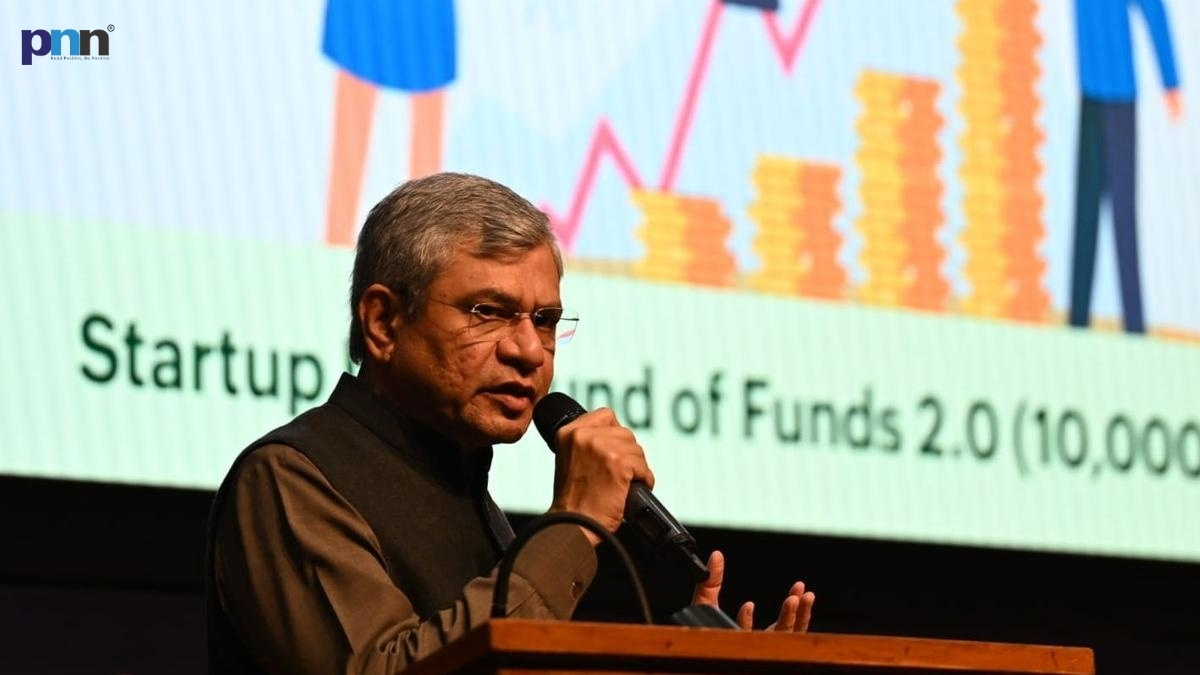
    The Cabinet has approved Startup India Fund of Funds 2.0 with a total corpus of ₹10,000 crore, to be disbursed over time through SEBI-registered Alternative Investment Funds (AIFs).

    The structure remains aligned with the original design philosophy. The government does not invest directly in startups. Instead, it acts as a catalytic investor in professionally managed venture funds.

    Implementation will continue through Startup India, with supervision by selected public financial institutions.

    This is policy forbearance in action. No drama. No disruption. Just scale.

    Why a Fund of Funds, Not Direct Cheques

    Governments are not venture capitalists, and they should not attempt to act like one.

    The Fund of Funds model recognises this reality. Rather than selecting winners from North Block, the state backs fund managers who understand opportunity, risk management, and founder dynamics.

    This approach offers three clear advantages.

    First, it multiplies impact. Every rupee invested by the Fund of Funds tends to attract several more rupees of private capital.

    Second, it avoids bureaucratic micromanagement.

    Third, it builds a long-term venture ecosystem instead of short-term subsidy dependence.

    Startup India Fund of Funds 2.0 remains firmly rooted in this logic.

    Lessons from the First Fund of Funds

    The original Fund of Funds, launched in 2016 with an announced corpus of ₹10,000 crore, played a subtle but significant role in India’s startup decade.

    Official data shows commitments to dozens of AIFs, which in turn supported hundreds of startups across sectors such as fintech, healthtech, SaaS, agritech, and deep tech.

    It did not create unicorns overnight. That was never the objective.

    What it did was enable early- and growth-stage funding at a time when India’s domestic venture capital base was still evolving. Many of today’s established fund managers emerged from that period.

    Fund of Funds 2.0 builds on this institutional memory.

    What Changes with Startup India Fund of Funds 2.0

    The environment has evolved, and the design reflects that shift.

    India today has a larger and more diverse startup universe. There are more regional founders, more sector-specialist funds, and increased focus on hardware, climate technologies, and manufacturing-linked innovation.

    The second fund is expected to place greater emphasis on:

    • Early-stage capital gaps

    • Emerging fund managers

    • Sector-focused AIFs

    • Wider geographic reach beyond metros

    This is less about chasing headlines and more about expanding the base.

    In simple terms, less froth and more fundamentals.

    India’s Startup Moment in 2026

    India no longer needs to prove that it can create startups. That debate is settled.

    The more pressing question is whether the ecosystem can produce sustainable companies at scale, across economic cycles.

    The approval of Startup India Fund of Funds 2.0 signals that the government understands this transition. The goal is not speed. It is sustainability.

    This matters because global capital is watching closely. Long-term investors favour countries that demonstrate policy consistency, capital depth, and institutional maturity. Trend chasers do not.

    Once again, India is choosing the quieter but more effective path.

    Implications for Founders and Investors

    This does not make money easy for founders. It makes money available.

    Capital will remain selective. Tough questions will continue. Burn rates will be scrutinised. That is healthy.

    For venture capital firms, especially first- and second-time managers, Fund of Funds 2.0 adds credibility. A government anchor investment can often determine whether a fund closes or stalls.

    For the broader economy, it reinforces a simple truth. Innovation is no longer peripheral. It has become core infrastructure.

    The Global Capital Signal

    This is also a message to the world.

    At a time when many economies are tightening their belts, India is signalling continuity. Rules are not being rewritten mid-cycle. The state is not stepping back from innovation financing.

    That predictability matters to long-horizon investors who value stability over hype.

    It also aligns with India’s broader push in manufacturing, digital public infrastructure, and technology-driven growth.

    PNN NATIONAL

  • China’s Zero-Tariff Gate to Africa: A Strategic Awakening Call for India

    China’s Zero-Tariff Gate to Africa: A Strategic Awakening Call for India

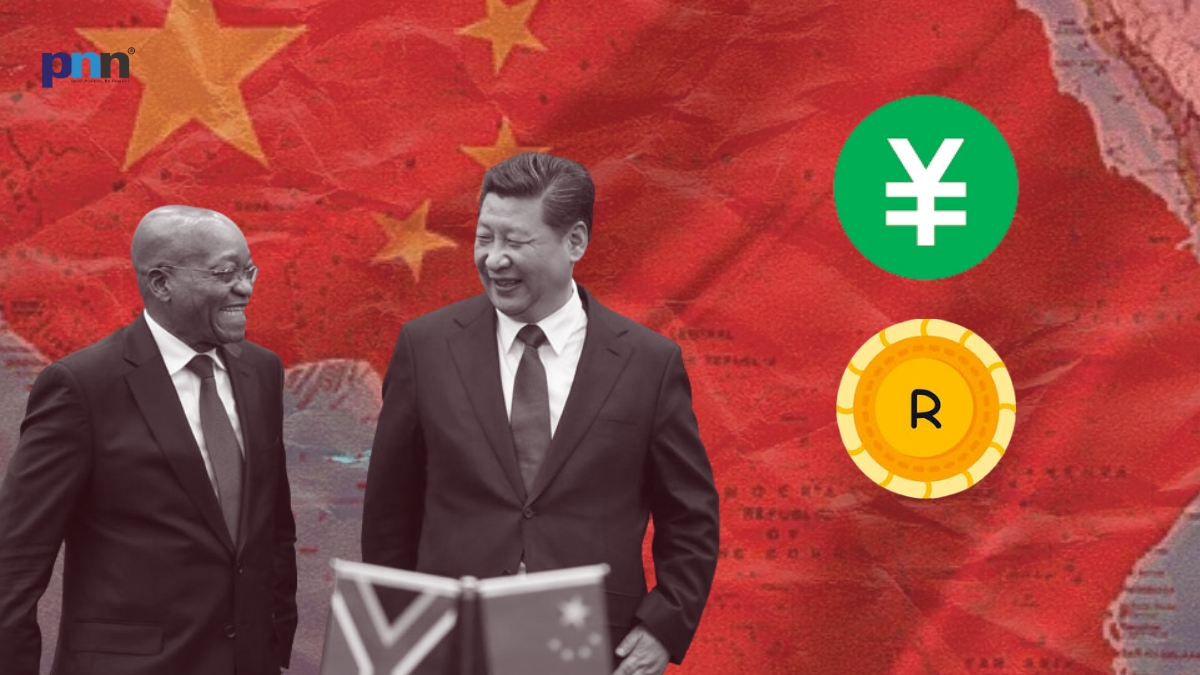
    New Delhi [India], February 14: When China declared that it would eliminate tariffs on imports from the majority of Africa from May 1, 2026, the policy was couched in terms of being development-friendly. But when looked at in terms of strategic trade, it is a measured step that reconfigures supply chains, diplomatic correlations, and competitive constructs – particularly for India.

    The decision increases an earlier zero duty arrangement that applied strictly to 33 African Least Developed Countries (LDCs). Now, the policy includes all 53 African countries that have diplomatic relations with Beijing. This is a critical distinction: the new list brings under the zero-tariff umbrella Africa’s economic heavyweights – South Africa, Nigeria, Egypt, and Kenya. It is not merely a symbolic concession to the poorest nations; it is a structural change to how the commodities, agricultural goods, and now industrial products will flow into the world’s second-largest economy.

    For policymakers and business leaders, however, the importance is not so much in the tariff cut itself as in the signal it sends.

    A strategy for Market Access Disguised as Development Policy
    Tariffs are one of the most effective levers in international economics. When a large market eliminates them, it is more or less an invitation for particular supply chains to deepen and expand. China’s decision tells African producers one thing very clearly: sell to us, and sell more.

    This complements Beijing’s long-standing infrastructure push throughout the continent through initiatives like the Belt and Road Initiative. Roads, ports, railways, and industrial parks have already lowered logistical barriers. Zero tariffs have now eliminated the price barrier.

    The result is a vertically integrated trade corridor where African raw materials and agricultural products come into China at a lower cost, are processed into products at Chinese factories, and return to the world’s general markets. It is a classic industrial strategy, carried out at the scale of the continent.

    Why This is Important For Global Trade

    For African exporters, the policy is simple: enhanced price competitiveness in one of the biggest consumer markets in the world. Duty-free access boosts margins and produces less uncertainty, and stimulates production.

    To China, the advantages are a sheer volume game. In 2025, China had an estimated trade of $348 billion with Africa, with Chinese exports dominating the trade. By getting rid of tariffs, China is essentially subsidizing its own supply chain. Lower-cost imports of minerals, metals, and agricultural inputs lower the cost base for Chinese manufacturers, making their exports even cheaper globally. Furthermore, Beijing has introduced “Green Lanes” to fast-track African agricultural goods that have created a logistical efficiency to which competitors will struggle to match.

    In a period of trade animosities and disintegration of global supply chains, having the cheapest inputs from a whole continent – including its industrial backyard – is not merely an economic choice. It is a geopolitical one.

    India’s Position: Cultural Goodwill Vs. Market Incentives
    India’s engagement with Africa, which today stands at about $100 billion of annual trade, has been based historically on common political histories with a large diaspora, development co-operation, and educational partnerships. Indian pharmaceuticals, IT services, and small-scale industrial ventures have earned a lot of goodwill from all African economies.

    But the key to trade is incentives.

    If African exporters are given zero-tariff access to the Chinese market, the gravitational force of that $348 billion ecosystem will be that much stronger. For the commodity exporters, even small differences in duty structures can change whole flows of trade. Over the years, then, China may emerge as the default destination for a greater variety of African exports.

    This change has two implications for India.

    First, there is the possibility that Indian importers will be subjected to more vigorous competition for Africa’s resources and agricultural products.

    Second, cheaper African inputs to Chinese factories could make Chinese-manufactured exports more competitive in the world economy – often at the expense of Indian producers, especially in sectors such as textiles and automotive components, in which South Africa and Egypt are key players.

    The Hidden Opportunity of Indian Business

    Despite the competitive dangers, China’s move also throws up indirect opportunities for Indian firms.

    Duty-free access to China will presumably lead African countries to expand production in sectors such as agriculture, mining, and simple manufacturing. As production scales up, these economies will experience a “services gap.” They will require supporting industries – logistics, pharmaceuticals, financial services, digital infrastructure, and skill development – which are also sectors where China’s hard-infrastructure focus is lacking.

    These are areas in which Indian companies have a natural advantage. India can present itself as a “Soft Power Integrator” for the growth of Africa. India’s private sector is especially robust in cheap healthcare, IT services, fintech (like Google model-based payments), education technology, small-scale manufacturing partnerships, etc. Rather than fighting China head-to-head on infrastructure or raw material trade, India can specialize in value-added layers around African growth.

    In effect, while China may have a monopoly over the extraction and commodity pipelines, India can still influence the service and industrial ecosystems that sit above them.

    Three Strategic Moves for India to Consider

    Targeted trade agreements
    Instead of generalized, symbolic frameworks, India should go in for selective trade deals with key African economies where it enjoys advantages in terms of sectors.

    Stronger export financing
    One reason why Indian firms are often losing ground is not due to poor quality or bad prices, but the lack of access to competitive financing. Expanding export credit and project finance tools may change that equation.

    Supply Chain Partnerships, Not Just Exports
    India’s Africa policy must be focused on co-production and local manufacturing, and not just as an export market.

    The Bigger Lesson: Market Access Is the New Diplomacy

    China’s zero-tariff policy is part of an overall trend in world economics. Market access is increasingly being used as a diplomatic instrument. Countries that make it easier to get their products into their markets can often achieve much more influence than the trade statistics indicate.

    For India, it is not a question of copying China’s tariff policy. The challenge is to create a coherent, long-term trade architecture with Africa that includes investment, supply chains, services, and strategic partnerships.

    Africa is to become one of the fastest-growing economic regions for the next two decades. The real question is not whether or not India participates, but how it positions itself.

    In China, China has opened the door of its market.

    India must now decide in which direction and to what extent it wants to open its own.

    PNN National

  • Gen Z Valentine Economy: 1 Generation, Many Industries Winning Big

    Gen Z Valentine Economy: 1 Generation, Many Industries Winning Big

    New Delhi [India], February 14: The Gen Z Valentine Economy is quiet, but categorical. Valentine’s Day is no longer used in a ritualistic, couples-focused way, but as a wider cultural phenomenon influenced by digital behaviour, emotional intelligence, and value-based purchases.

    For Gen Z, the celebration of Valentine’s Day no longer revolves around chivalrous acts or anticipated spending. It is about expression, timing, and shareability. The gift does not tell even half the story. The rest of the work is done by the experience, the post, the memory, and the relevance.

    This is not rebellion. It is evolution.

    Gen Z is born into smartphones, algorithms, and unlimited choice, which shapes their attitude toward consumption differently. They reward brands that avoid extravagance, respect individuality, and deliver emotional payoff without overshooting.

    Why Gen Z Spends Differently

    The Gen Z Valentine Economy is defined more by values than by budget limitations. This generation is not anti-consumption. It is anti-waste, anti-performance, and acutely allergic to performative romance.

    Gen Z has made Valentine’s Day inclusive. Friends count. Self-love counts. Experiences count. The old-fashioned notion that February 14 exists only for couples no longer holds in a world where identity and relationships are fluid.

    According to industry data, Gen Z consistently values authenticity, practicality, and emotional relevance. They are willing to spend, but only where they feel genuine value. Expensive does not equal meaningful. Visible does not equal valuable.

    These attitudes have opened new avenues for businesses willing to adapt.

    Creator Economy: Gifting Goes Public

    The creator ecosystem is among the biggest winners in the Gen Z Valentine Economy. Valentine’s Day is now peak content season, not merely a retail moment.

    Brands are no longer just selling products. They are enabling stories.

    What once defined influencer gifting as limited to beauty and luxury has expanded to cafés, subscription services, digital platforms, experience brands, and even small local businesses. The goal is no longer reach alone. It is relatability.

    Traditional Valentine advertising has been replaced by short-form video, especially reels. An informal café date recorded on a phone often performs better than a polished campaign. Gen Z trusts creators who feel human, not aspirationally distant.

    For this generation, a gift that translates into content carries disproportionate value. It wins when it tells a story, evokes emotion, or becomes part of everyday life.

    Power of Personalisation and D2C Brands

    Another clear beneficiary of the Gen Z Valentine Economy is direct-to-consumer brands. Their core strength is agility.

    From customised skincare sets and handcrafted chocolates to minimal jewellery and perfumes, D2C brands understand what Gen Z wants: control, choice, and character.

    Valentine’s Day has shifted from short-term sales spikes to long-term relationship building. Personal notes, pricing flexibility, limited quantities, and gender-neutral positioning align with a generation that values inclusivity and transparency.

    Self-gifting has also entered the mainstream. Many Gen Z consumers now buy Valentine’s products for themselves, not to conform, but as an act of self-care, making the occasion personal rather than performative.

    For D2C brands, this is not a seasonal win. It is a brand-building opportunity.

    Experiences Over Objects

    The shift toward experiences is perhaps the defining trait of the Gen Z Valentine Economy.

    Themed café menus, live performances, comedy shows, art workshops, pop-ups, and immersive experiences are seeing rising demand, especially in urban India. The product is not the ticket. It is the memory.

    Gen Z derives emotional value from experiences. They encourage connection, conversation, and content creation. Crucially, they are not permanent. An unused object can feel meaningless compared to a memorable night out.

    The celebration window has also expanded. Valentine-themed weekends and post-Valentine events now stretch commercial opportunities well beyond February 14.

    For hospitality, entertainment, and event businesses, this shift is structural, not temporary.

    Digital Gifting Comes of Age

    Digital gifting has quietly become one of the most practical expressions of the Gen Z Valentine Economy.

    Music and video subscriptions, fitness apps, gaming vouchers, curated playlists, and digital credits are increasingly popular. These gifts are instant, flexible, and affordable, qualities Gen Z values highly.

    Unlike physical gifts, digital offerings integrate seamlessly into daily life. Their value is not limited to the occasion, making them feel more personal and less performative.

    Experimental formats such as NFTs remain niche, but mainstream digital gifts continue to grow because they solve real problems. They are accessible, low-pressure, and relevant.

    In a world of limited time and attention, convenience is emotional.

    India’s Gen Z Valentine Playbook

    In India, the Gen Z Valentine Economy is shaped by cultural sensitivity and creative pragmatism.

    Young consumers across metros and emerging cities are choosing café hopping, shared experiences, digital gifting, and social-first celebrations over expensive dinners or traditional gifts.

    Creativity is prioritised over extravagance. Moments over markers. Connection over convention.

    This shift mirrors broader changes in Indian youth consumption. Gen Z, unlike previous generations, is comfortable blending global trends with local sensibilities. They celebrate differently, but deliberately.

    What This Means for Businesses

    The takeaway is simple. Valentine’s Day is no longer just a retail event. It is a cultural moment.

    Brands that succeed in the Gen Z Valentine Economy understand emotional logic. They prioritise relevance over luxury, experience over excess, and authenticity over polish.

    As Gen Z gains spending power, these trends will only strengthen. The future of Valentine’s Day belongs to businesses that show up meaningfully, not loudly.

    In this economy, love is not merely exchanged. It is shared, personalised, and experienced. Often in under 30 seconds.

  • NIS Management Limited Reports Q3 FY26 Revenue of Rs 103.77 Cr; 9M Revenue Stands at Rs 318.66 Cr

    NIS Management Limited Reports Q3 FY26 Revenue of Rs 103.77 Cr; 9M Revenue Stands at Rs 318.66 Cr

    Kolkata (West Bengal) [India], February 14: NIS Management Limited(BSE – 544495), One of leading integrated services platforms, specialising in security, facility management, electronic security, and skill development, NIS Management Limited has announced its Unaudited Q3 & 9M FY26 Financial Results.

    Key Consolidated Financial Highlights of Q3 FY26

    • Total Income of ₹ 103.77 Cr
    • EBITDA of ₹ 5.69 Cr
    • EBITDA Margin of 5.48%
    • PAT of ₹ 2.83 Cr
    • PAT Margin of 2.73%
    • EPS of ₹ 1.43

    Key Consolidated Financial Highlights of 9M FY26

    • Total Income of ₹ 318.66 Cr
    • EBITDA of ₹ 22.42 Cr
    • EBITDA Margin of 7.04%
    • PAT of ₹ 13.05 Cr
    • PAT Margin of 4.10%
    • EPS of ₹ 7.59

    Commenting on the Financial performance Mr. Debajit Choudhury Chairman & Managing Director, of NIS Management Limited said, “We are pleased to report a steady performance for Q3 and 9M FY26. During Q3 FY26, we achieved consolidated total income of ₹ 103.77 Cr with PAT of ₹ 2.83 Cr, while for 9M FY26, total income stood at ₹ 318.66 Cr and PAT at ₹ 13.05 Cr. The performance reflects consistent demand across our core security and integrated facility management services, supported by strong execution across multiple states and client segments.

    Our diversified service portfolio, large trained workforce, and long-standing client relationships continue to provide revenue stability and operational leverage. We are also seeing encouraging traction in technology-enabled security and higher-value facility management services, which is supporting margin improvement.

    Going forward, we remain focused on strengthening our integrated service offerings, improving operating efficiencies, and expanding into higher-margin segments while maintaining service quality and disciplined growth.”

    Disclaimer: This article is for informational purposes only and does not constitute financial advice.

  • Exide Empowers Future Engineers

    Exide Empowers Future Engineers

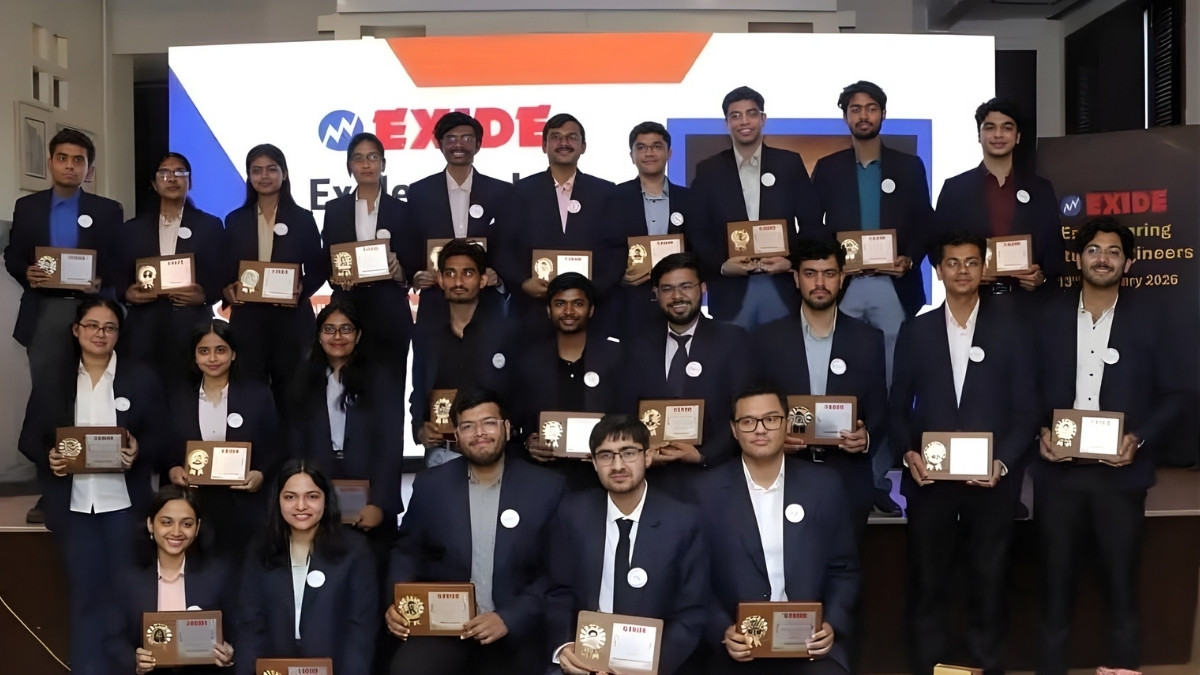
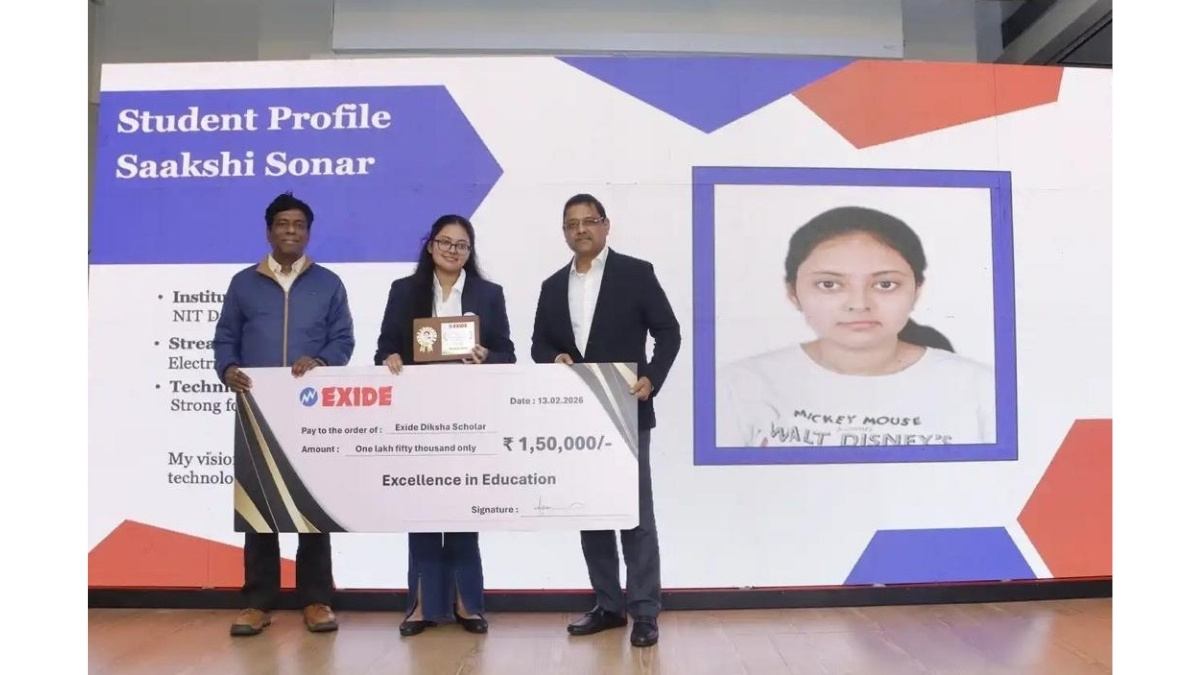
    Kolkata (West Bengal) [India], February 14– Exide Industries Limited has launched the Exide Diksha Scholarship, a merit-based scholarship program curated as part of its Corporate Social Responsibility (CSR) initiatives.

    The inaugural edition of the scholarship was rolled out across three premier institutions viz Jadavpur University, Indian Institute of Engineering Science and Technology Shibpur, and National Institute of Technology Durgapur. This marks the beginning of a long-term commitment to nurture young engineering talent in eastern India for the manufacturing industry, the future backbone of developed India. This initiative is set to expand to additional colleges across East and Northeast India next year.

    Exide Empowers Future Engineers-pnn

    The scholarship was open exclusively to the top 15 students from the Mechanical, Electrical, and Chemical Engineering departments of the participating institutions. These streams were thoughtfully chosen as students from these disciplines will play a vital role in shaping the future of the battery and energy storage industry.

    Following a structured selection process that included project evaluation and personal interviews, 24 students were chosen as the first cohort of Diksha Scholars.

    More than a scholarship, Exide Diksha reflects a shared commitment between industry and academia to nurture capability and ambition. By engaging directly with students through structured assessments and interactions, the program aims to bridge classroom learning with real-world industry exposure.

    About Exide Industries Limited
    Exide Industries Limited is one of India’s leading manufacturers of lead-acid storage batteries and power storage solutions, serving diverse sectors across automotive, industrial, and energy applications. Through its CSR initiatives, Exide continues to invest in education, community development, and sustainable growth.

    If you object to the content of this press release, please notify us at pr.error.rectification@gmail.com. We will respond and rectify the situation within 24 hours.


  • Mega ResoFast 2026 – Top 100 Achievers Awarded Tablets by Resonance

    Mega ResoFast 2026 – Top 100 Achievers Awarded Tablets by Resonance

    Top 100 Achievers Awarded Tablets by Resonance

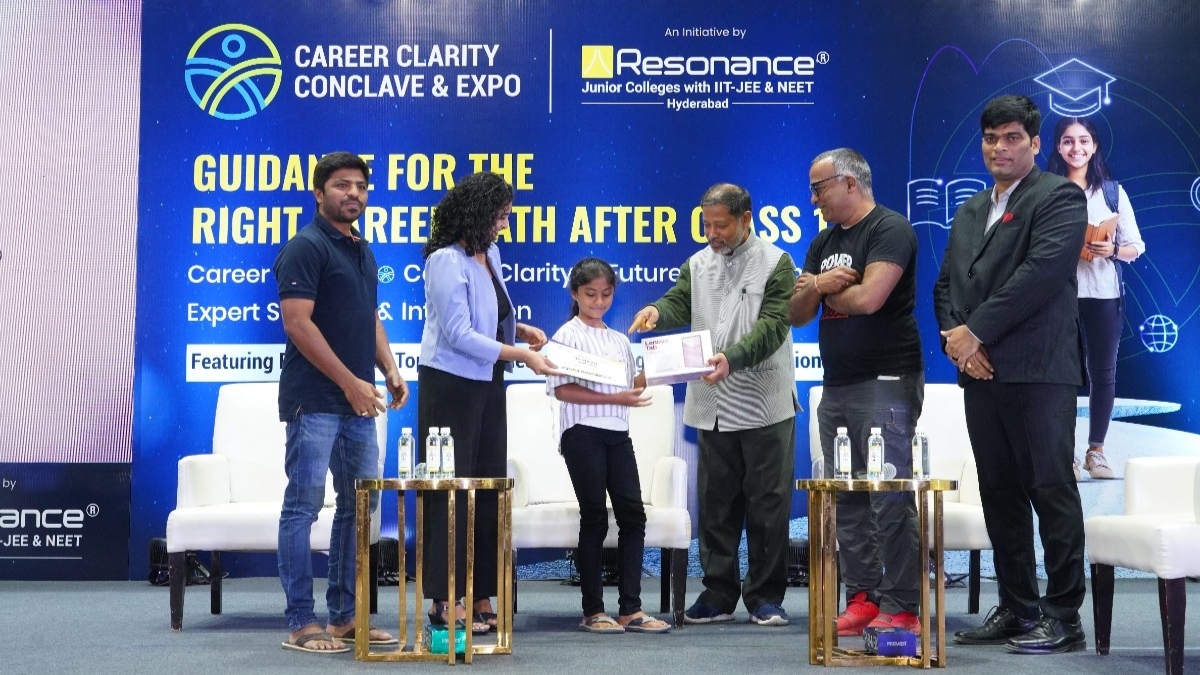
    Hyderabad (Telangana) [India], February 14: Mega ResoFAST (Resonance Future Achievers Scholarship Test) is an online test conducted across Hyderabad on December 14, 2025. The top achievers from various schools across Telangana were presented with tablets by the guests. It is the fulfillment of one of the commitments made by Resonance Institutions Hyderabad, as mentioned in the Mega ResoFAST web portal.  

    Mega ResoFast: Short Detailing 

    Mega ResoFast goes a step further by recognising talent and encouraging them through a range of benefits for those who pass the exam. Depending on their scores and ranks, students must take two additional qualifying exams to receive higher benefits, up to a 100% scholarship. To better understand the benefits, readers should focus on the highlights below.

    Highlights of the Mega ResoFAST(Resonance Future Achievers Scholarship Test)

    1. Benefit: Scholarship waiver up to 100% | Rewards: 100 tablets
      1. Scholarships Worth ₹100 Crores: Hyderabad’s largest merit-based scholarship pool for students of Grades V to X.
      2. Top performers can secure full fee (100%) waivers on select flagship programs for the 2026-27 academic year.
      3. 100 Learning Tabs: High achievers stand a chance to win 100 tablets to support smart, digital learning.
    2. Career Guidance: Mentorship | Free online programs 
      1. Career experts identify the student’s strengths, gaps, and growth potential, and provide a comprehensive Performance Report.
      2. Top Mega ResoFast achievers will get online academic support through Resonance E-learning programs.

    Guests presiding over the seminar sessions Presented Tablets 

    • On the occasion of the Career Clarity Conclave & Expo 2026, Resonance Institutions proudly invited the top 100 Mega ResoFast winners, along with their parents, to be honoured on stage. The chief guests presiding over each session personally presented tablets to the winners as a mark of recognition and encouragement.

    Guests who presented the tablets to the top Mega ResoFast winners:

    • Ramesh Loganathan — Dean, IIIT Hyderabad
    • Dr. Rama Sastry Vedula — Dean, Core Engineering, GITAM (Deemed to be University)
    • Rahul Attuluri — Co-founder & CEO, NxtWave
    • Dr. B. Bala Raju — Senior Consultant (General Physician), Yashoda Hospitals
    • Sudhakar Rao — Director of Branding, ICFAI

    Director’s Message to Mega ResoFast Achievers

    Heartiest congratulations to our Top 100 Mega ResoFast winners! Your discipline, effort, and determination have brought you this proud moment, and we are truly delighted to celebrate your achievement.

    At Resonance, we believe recognition should be meaningful and future-focused. As we committed, we have presented a tablet to each of the Top 100 winners—not just as a gift, but as a learning tool to support smart, digital study, better practice, and stronger performance in the days ahead.

    I also appreciate the parents for their constant encouragement and support. Keep learning, keep growing, and keep aiming higher—Resonance will always stand with you in your success journey.

    About Resonance: 

    Resonance has trained over 1 million students, of whom 3.3 lakh have secured admission to IITs, NITs, premier technological universities, and top medical colleges. In 2018, Resonance expanded its footprint to Hyderabad and began operations under the leadership of Mr. Narra Purnachandra Rao. Since then, Resonance Colleges Hyderabad has grown rapidly, expanding to 34 campuses across the city. Building on this strong legacy, Resonance has now also launched new Resonance Schools campuses across Hyderabad, bringing the same proven academic ecosystem to younger learners.

    If you object to the content of this press release, please notify us at pr.error.rectification@gmail.com. We will respond and rectify the situation within 24 hours.

  • Varvee Global Limited (VGL) Reports Positive Q3FY26 Growth: Triple-Digit Revenue Gains and 85 Percent 9M Gross Margins

    Varvee Global Limited (VGL) Reports Positive Q3FY26 Growth: Triple-Digit Revenue Gains and 85 Percent 9M Gross Margins

    Structural Shift to High-Yield Non-Denim Portfolio; Balance Sheet De-risked with India Ratings ‘Positive’ Outlook

    Ahmedabad (Gujarat) [India], February 14: Varvee Global Limited (“VGL” or the “Company”) has announced its financial results for the quarter (Q3 FY26) and nine months ended December 31, 2025 (9M FY26). The results mark a strategic inflection point, as the Company transitions from a successful operational turnaround to a high-velocity growth phase, characterized by sector-leading margins and a fortified capital structure.

    Varvee Global Limited (VGL) Reports Positive Q3FY26 Growth: Triple-Digit Revenue Gains and 85 Percent 9M Gross Margins-PNN

    Q3 & 9M FY26 Key Takeaways

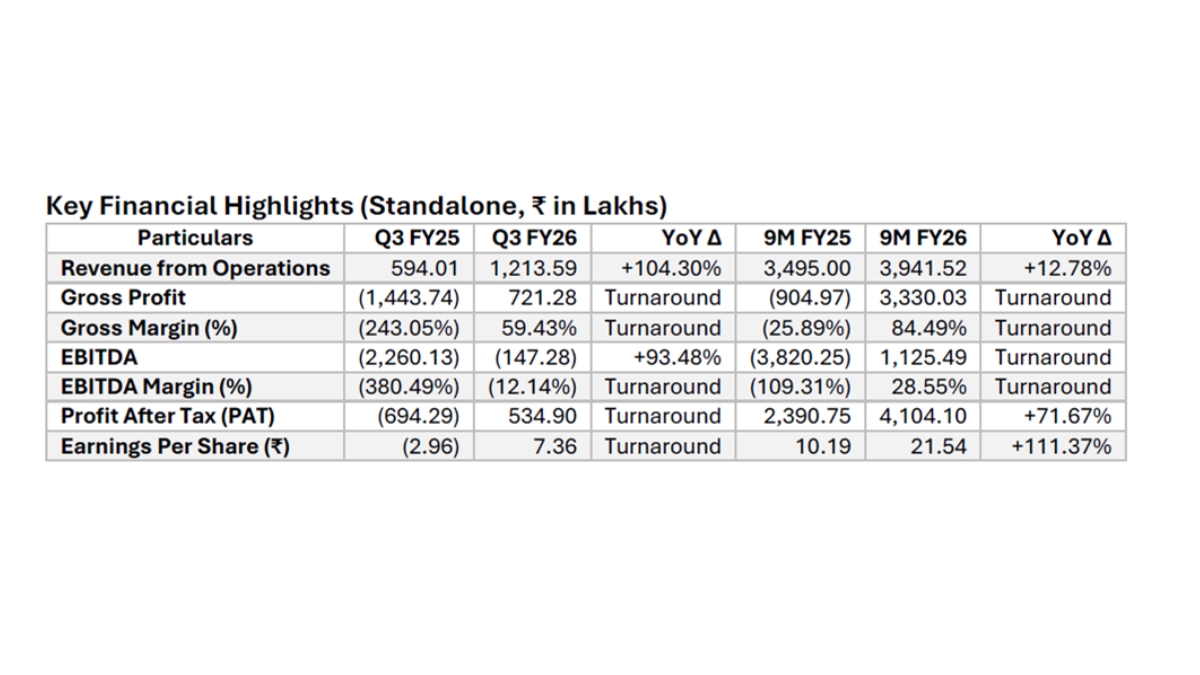
    The Company achieved a significant 9M EBITDA turnaround, reaching ₹1,125.49 lakh compared to a loss of ₹3,820.25 lakh in the prior-year period. While the Q3 EBITDA remains slightly negative due to timing and reinvestment, the 93.5% reduction in Q3 operating loss reflects a trajectory toward sustainable profitability.

    VGL’s deliberate shift away from legacy, commoditized denim toward value-added Non-Denim Shirtings and Suitings is now reflected in its 9M Gross Margin of 84.49%, a turnaround from a negative margin last year. This represents a substantial bps expansion YoY, proving the superior unit economics of the new management’s product mix alongside an 86.1% reduction in 9M raw material costs following a strategic portfolio rationalization.

    While 9M revenue grew 12.78%, 9M PAT surged by 71.67% to ₹4,104.10 lakh. This highlights significant operating leverage, where a lean, restructured cost base, including a reduction in employee costs achieved earlier in the year, is translating incremental revenue directly to the bottom line.

    Employee expenses for the nine-month period were reduced by 48.69% YoY to ₹307.67 lakh, showcasing the lean operational structure implemented by the new leadership.

    Finance costs for Q3 were effectively eliminated (₹0.03 lakh), a 99.99% reduction from Q3 FY25, following the full retirement of high-cost legacy debt.

    Institutional Milestones: Credit Rating & Capacity Scaling

    In a major institutional milestone, India Ratings and Research assigned an ‘IND BB/Positive’ issuer rating to VGL on January 28, 2026. This follows the withdrawal of the legacy ‘IVR D’ (Default) issuer non-cooperating rating by Infomerics on December 31, 2025, after the Company secured “No Due Certificates” from all major lenders, including SBI and Bank of Baroda, as well as confirmation of “No Dues” with respect to its fixed deposits. The ‘Positive’ outlook displays the Company’s robust liquidity and the sustainability of its turnaround.

    On January 5, 2026, VGL announced a 50% increase in production capacity for non-denim fabrics, scaling from 12 lakh to 18 lakh meters per month. This is an interim step toward the management’s long-term goal of 50 lakh meters per month, positioning VGL to capture high-margin demand in a domestic textile market projected to reach USD 250 billion by 2030–31.

    Management Outlook

    “Our Q3 and 9M results reflect a fundamental turnaround in VGL’s earning capability. By delivering 9M gross margins of 84.5% and achieving a positive 9M EBITDA, we have proven that our focus on premium non-denim fabrics is the correct path for long-term growth. The assignment of a ‘Positive’ rating outlook from India Ratings marks our transition into a more stable, institutional-grade financial profile. We are now aggressively scaling; our expansion to 18 lakh meters per month is just the first step toward our 50-lakh-meter goal. We remain committed to compounding free cash flow and maintaining a debt-free balance sheet as we capture the expanding opportunities in the Indian textile market.”

    — Mr. Jaimin Gupta, Chairman & Managing Director

    About Varvee Global Limited & TAM

    Headquartered in Ahmedabad, Varvee Global Limited (previously known as Aarvee Denims & Exports Ltd.) is a leading integrated textile manufacturer offering a comprehensive range of denim, non-denim, shirting, and suiting fabrics. Operating primarily from its Narol facility, Varvee Global Limited delivers end-to-end in-house capabilities, from yarn production to finishing, ensuring consistency in quality and flexibility in supply. Over three decades, Varvee Global Limited has built a vertically integrated platform serving domestic and international markets. Following a strategic restructuring and leadership transition in 2025, Varvee Global Limited now operates from its high-capability Narol unit, with a renewed focus on operational efficiency, cost optimisation, and technology-led supply chain enhancements.

    The Company achieved a debt-free status in June 2025, providing a stronger capital foundation to execute its revival plan. The Indian textile market, valued at USD 146.55 billion in 2024, is projected to reach USD 213.51 billion by 2033, with domestic demand and exports expected to hit USD 250 billion and USD 100 billion, respectively, by 2030–31. Within this, India’s denim industry has an installed capacity of 1,700 lakh meters, producing around 1,000 lakh meters annually (60–70% utilization), and the denim apparel market is forecast to grow from USD 1.14 billion in 2024 to USD 1.83 billion by 2033 at a 5.04% CAGR, with other estimates projecting USD 9.15 billion by 2026 at a 14% CAGR. Varvee Global Limited’s strategy is centred on expanding into emerging markets, diversifying into value-added fabrics, and aligning with global sourcing trends to capture new opportunities in both fashion and industrial textile segments.

    With a heritage of manufacturing excellence, a restructured balance sheet, and a future-ready operational model, Varvee Global Limited is positioning itself for sustainable value creation in the textile industry.

    Sources: Wazir Advisors, IMARC Group, MarkWide Research, IJIRT, PIB, and Henry Textile.

    If you object to the content of this press release, please notify us at pr.error.rectification@gmail.com. We will respond and rectify the situation within 24 hours.


  • Happyyou 24|7 Offers Holistic E-Mental Health for a Healthier India

    Happyyou 24|7 Offers Holistic E-Mental Health for a Healthier India

    Bengaluru (Karnataka) [India], February 14 Happyyou 24/7, a digital mental health initiative by Basilmind Private Limited, provides round-the-clock access to mental health services through an online platform. Established in 2020, the platform delivers therapy, psychiatric care, sexual health support, and wellness programs aimed at addressing mental health needs across different age groups and life stages.

    Founded Amid Rising Mental Health Concerns

    The inspiration behind Happyyou 24|7 came from Dr. Subram Sannapareddy, a highly regarded psychiatrist whose frontline experience at Apollo Hospitals and personal mission to bridge the mental health gap laid the groundwork for the platform’s launch in 2020. The urgency of the Covid-19 pandemic, coupled with a global call from the WHO to “Invest in Mental Health,” propelled his vision into action.

    Happyyou 24/7  Key services include:

    1. Therapy Services

    Delivered by certified psychologists and counselors, Happyyou 24|7’s therapy programs are tailored to help individuals deal with:

    • Stress, anxiety, depression, burnout, phobias
    • Relationship issues, career dilemmas, low self-esteem
    • Emotional regulation and lifestyle challenges

    Therapies offered include CBT, DBT, mindfulness-based therapy, psychodynamic therapy, and more – all conducted online with complete confidentiality.

    2. Psychiatric Support

    For those who need clinical diagnosis and medical intervention, Happyyou 24|7 offers:

    • Online consultations with licensed psychiatrists
    • Evaluation and treatment for depression, OCD, insomnia, anxiety spectrum disorders, etc.
    • Medication management, follow-ups, and treatment planning

    This ensures that clients not only receive talk therapy but also appropriate medical care when necessary.

    3. Sexual Health

    Recognizing the stigma and silence surrounding sexual well-being in India, Happyyou 24|7 offers a safe, private space to discuss:

    • Intimacy issues, sexual dysfunction, identity questions
    • Trauma, shame, or relationship-related sexual concerns

    Sessions are handled by trained professionals with sensitivity, aiming to normalize conversations around sexual health and empower individuals in their personal journeys.

    Healing the Mind. Empowering Life.

    At the heart of Happyyou 24|7’s model is its holistic, integrated approach to mental health. The platform’s services encompass:

    • Therapy and Counseling: For stress, depression, anxiety, relationship concerns, sleep disturbances, and more.
    • Mindfulness & Relaxation Techniques: Including yoga, guided meditation, and nutrition counseling.
    • Wellness Programs: Custom-curated mental wellness workshops for schools, colleges, and corporations.

    This whole-person approach – guided by the philosophy “Healing the Mind. Empowering Life.” – ensures that every individual not only finds relief from symptoms but also develops the skills to thrive with clarity, purpose, and positivity.

    A Vision Rooted in Accessibility and Ethics

    Backed by a purpose-driven team of psychologists and health experts, Happyyou 24|7 is redefining mental health care through:

    • 24/7 online accessibility, breaking barriers of time and location
    • Affordable pricing, making care reachable for all income levels
    • Personalized care plans, integrating therapy with ancient wellness practices
    • Ethical foundations, built on respect, sensitivity, and open-mindedness

    Whether you’re a working professional coping with stress, a parent concerned about your child’s development, or a student facing anxiety – Happyyou 24|7 helps you gain the tools, insights, and strength to live a more meaningful, joyful life.

    About Happyyou 24|7

    Happyyou 24|7, established in 2020, is a digital mental health and wellness initiative by Basilmind Pvt. Ltd., headquartered in Bangalore. With a comprehensive service portfolio ranging from psychiatric care to mindfulness programs, the platform is transforming how individuals and institutions approach mental wellness in India.

    For more information or to book a consultation, visit www.happyyou247.com

    If you object to the content of this press release, please notify us at pr.error.rectification@gmail.com. We will respond and rectify the situation within 24 hours.


  • IIT-Bombay Startup Infiheal Launches DuoChat, World’s First AI Relationship Coach

    IIT-Bombay Startup Infiheal Launches DuoChat, World’s First AI Relationship Coach

    New Delhi [India], February 14: Infiheal, an IIT Bombay mental health startup, has launched DuoChat, described as the world’s first AI relationship coach designed to help two people communicate together in real time and build stronger relationships.

    The product was introduced at the official pre-summit hosted by Infiheal and IGAP leading up to the India AI Summit 2026 in New Delhi, where senior leaders from major technology firms, public policy institutions, healthcare systems, international organizations, academic research centers, and regulatory authorities gathered to shape the future of responsible artificial intelligence.

    DuoChat’s release comes just ahead of Valentine’s Day, a time when conversations around love, compatibility, emotional connection, and relationship health naturally take center stage. While the season often focuses on celebration, mental health experts note that it also highlights communication gaps and unresolved tensions in partnerships — making early-stage support tools particularly relevant.

    Over the past decade, digital mental health tools have largely focused on individuals — offering support for anxiety management, emotional regulation, and personal resilience. However, research increasingly underscores that emotional well-being is deeply relational.

    A 2023 survey by the American Psychological Association found that nearly 60 percent of adults reported significant stress linked to friendships, family dynamics, or workplace communication — stressors that directly affect relationship quality.

    Despite this awareness, relationship support often remains reactive. Couples therapy is frequently sought only during crises, and access barriers — including cost, stigma, and long waitlists — can delay intervention. Many individuals attempt to resolve conflict independently, without a shared framework for constructive dialogue.

    Building a Shared AI-Facilitated Space

    Infiheal previously launched Healo, an AI mental health companion offering guided emotional support and therapist matching. Within just over a year, Healo grew to more than one million users, with 91 percent reporting improvement in how they felt after using the platform.

    During that expansion, the team observed a consistent pattern: a majority of user conversations centered on relationships — romantic, familial, and social. Users frequently uploaded screenshots of difficult exchanges, asking the AI to interpret tone and intent. While this offered individual clarity, it did not address the relational dynamic itself.

    DuoChat was built to bridge that gap.

    The platform creates a private, confidential chat environment where two participants engage simultaneously. The AI functions as a facilitator — not a replacement for communication. It introduces structured prompts, reflection cues, and perspective-building interventions designed to reduce defensiveness, prevent escalation, and clarify misinterpretations. Drawing from established relationship science and evidence-based therapeutic frameworks, the system intervenes selectively — primarily when conversations become heated or when guided reflection may restore empathy and understanding.

    Early-Stage, Preventative Support

    Globally, demand for counseling continues to outpace supply, leaving many couples and families waiting weeks or months for professional support. During these gaps, emotional distance can deepen.

    DuoChat positions itself as early-stage support — not therapy, but a preventative tool aimed at encouraging healthier dialogue before disconnection becomes entrenched.

    “We’ve built AI platforms to optimize productivity, entertainment, and even shopping. But we haven’t focused enough on leveraging AI to help people understand each other,” said Srishti Srivastava, Founder and CEO of Infiheal. “DuoChat is our attempt to shift AI toward strengthening human relationships, not replacing them.”

    India-Led Innovation in Mental Health AI

    Founded by Srishti Srivastava and Utkarsh Srivastava, Infiheal develops clinically validated AI models for mental healthcare within responsible AI frameworks, emphasizing safety and trust. The company has been recognized by Narendra Modi, in Mann Ki Baat and has showcased its work at global platforms such as the World Economic Forum in Davos.

    With DuoChat launching around Valentine’s Day, the startup expands its mission to make mental health support accessible, affordable, and stigma-free — while reframing AI not just as a tool for individual optimization, but as a bridge for stronger human connection.

    If you object to the content of this press release, please notify us at pr.error.rectification@gmail.com. We will respond and rectify the situation within 24 hours.

  • Rishab Agarwal’s Petition Challenging WeWork India IPO Disclosures Withdrawn Unconditionally

    Rishab Agarwal’s Petition Challenging WeWork India IPO Disclosures Withdrawn Unconditionally

    Mumbai (Maharashtra) [India], February 14: A petition challenging WeWork India’s initial public offering prospectus has been withdrawn by the petitioner. The Bombay High Court withdrew the writ petition after similar petitions were dismissed in December 2025.

    The matter was listed before a division bench of Justice R.I. Chagla and Justice Advait Sethna.

    “By Praecipe bearing today’s date, the learned Advocate for the Petitioner has sought for leave to withdraw the Writ Petition (L) No. 32194 of 2025 unconditionally. Accordingly, leave is granted. Writ Petition (L) No. 32194 of 2025 is disposed of as withdrawn”, the Court noted in its order.

    The petitioner argued that WeWork India concealed key regulatory complaints in its IPO prospectus, withholding complaints lodged by certain entities.

    In the earlier decision by Bombay HC, the Court also dealt with objections founded on the issuer’s financial position and clarified that Regulation 6 (2) of ICDR regulations provides a statutory route for issuers to proceed through book-building with the required institutional allocation, even where certain financial eligibility conditions are not met placing emphasis on robust risk-factor disclosures rather than a merits review of the business.

    The petitions were argued by senior advocates and involved technical debates on securities law, disclosure norms and the obligations of issuers under SEBI regulations. It raised a natural question. How do small retail investors, presumably with limited stakes, secure such representation for complex issues that are normally raised by institutional investors or specialised advisory firms.

    “The resolution of all three petitions reaffirms the integrity of India’s securities regulatory framework and sends a clear message that judicial processes cannot be misused for extraneous commercial purposes”, said a  WeWork India Spokesperson.

    The withdrawal removes an active strand of litigation around the WeWork India IPO disclosure narrative and leaves the High Court’s earlier reasoning as the operative benchmark on these challenges particularly its reaffirmation of SEBI’s approval process, the centrality of “true and adequate” material disclosures, and the Court’s reluctance to convert writ jurisdiction into a parallel merits review of an offer document already examined within the statutory framework.